Showing posts with label art. Show all posts

Thursday, 1 May 2025

Exhibitions at The Scottish Gallery

 I've long admired the work of willow weaver Lizzie Farey so was particularly keen to get along to her show at The Scottish Gallery in Edinburgh's Dundas Street. Her work is being shown alongside several other artists and crafters.

The gallery takes up two floors of a Georgian Terrace in Edinburgh's famous New Town. These exhibitions pack a lot in, but nothing seems crowded. As well as Lizzie Farey's beautiful wall art (see an example here) and her sculptures (see an example here) highlights included wood fired pottery from Nancy Fuller, Still Life paintings from a range of artists including Ewan McClure and beautiful paintings of nature by Naoka Shibuya.

I was particularly interested in the way that both Lizzie Farey and Nancy Fuller work so closely with the natural environment. Lizzie uses willow harvested from her own willow field along with foraged pussy willow, larch, bog myrtle, reeds and rushes. Her wall art is inspired largely by plantlife and her sculptures all have a feeling of organic form. As she says herself on the gallery website: "Natural forms provide both the foundation and inspiration for my work". Nancy Fuller meanwhile works in a croft in Aberdeenshire, using traditional methods from Taiwan, her place of birth. 

The paintings by Ewan McClure in the exhibition are inspired by the work of the famous Scottish colourist S J Peploe, and in fact feature props used by Peploe himself as loaned to the artist by Peploe's grandson. 

Naoka Shibuya's paintings include beautifully rendered paintings of birds and plants, with interesting bits of abstract or unrelated detail brought in, but in a way that only adds to the overall effect. 

There are many other artists on display here, far too many to mention.  The current exhibitions run only until Friday 3 May then the gallery will be closed until a new group of exhibitions will start on 8 May. 

The gallery also has a lovely garden behind the building, which is only open when the weather is fine. It's a beautiful, peaceful space, sadly my photos below don't do it justice! 


It features corton steel sculptures by Andrea Geile, including the one below, A Wild Land

what I particularly liked about this piece is that, if you look closely, it seems to frame a lovely Wall-rue fern (Asplenium ruta-muraria)


 I then became fascinated by the tulips in the garden, some of which are starting to fade, but actually becoming particularly lovely 


Sunday, 10 December 2023

Weekend Landscapes


I had a lovely lunchtime walk with a friend on Friday, walking round Harrison Park, which sits next to the Union Canal which passes through Edinburgh. The weather was mild, and the skeleton trees looked lovely. Several Redwings were running around on the grass and three Goosanders were floating in the canal.

Yesterday it was pouring for most of the day. Crafty Green Boyfriend and I braved the rain for a walk along the Water of Leith. We were rewarded with the lovely sight of a mother otter with her two cubs, running along the riverbank and swimming upstream. No photos or videos, but it was a wonderful thing to watch! 

I also went along with a friend to see the lovely Scottish Landscape Awards exhibition at the City Art Centre. It's a lovely exhibition of paintings, prints and other landscape inspired artworks. My favourite was the coral reef made from felt and beads and other assorted materials. The exhibition runs until March 2024. 

As ever, coloured text contains hyperlinks which will take you to other websites where you can find out more

Thursday, 17 November 2022

Artworks on the National Cyclepath Network

Sustrans Scotland, the charity for sustainable transport, is currently marking Disability History Month with a series of art installations by disabled artists. The installations are in Paisley, Dumfries and Edinburgh. You can find out more about the project here. 

Today I visited one of the installations at lunchtime. I popped along to the Warriston section of the Water of Leith Walkway to look at the installation by Sasha Saben Callaghan. Her beautiful collages 'take the histories of six disabled 'pauper inmates' from Leith's Poorhouses and transforms their stories into the mythical, the beautiful and the uncanny'. 


It's well worth popping along to see these lovely collages, though I was disappointed that they were relatively small, There's so much detail in the collages themselves that they would have looked even better if they had been reproduced at a larger size. You can see more of Sasha's artwork on Instagram here and you can watch a wee video about her installation here.

This installation will be in place until 16 December. 

Sustrans nationally in the UK has a number of public artworks and art trails, you can read more about them here.  

Meanwhile, Kate Bell shares her experiences of cycling with disabilities on the Sustrans website here.


Wednesday, 18 March 2020

Lovely art exhibition inspired by birch trees at the Birch tree Gallery

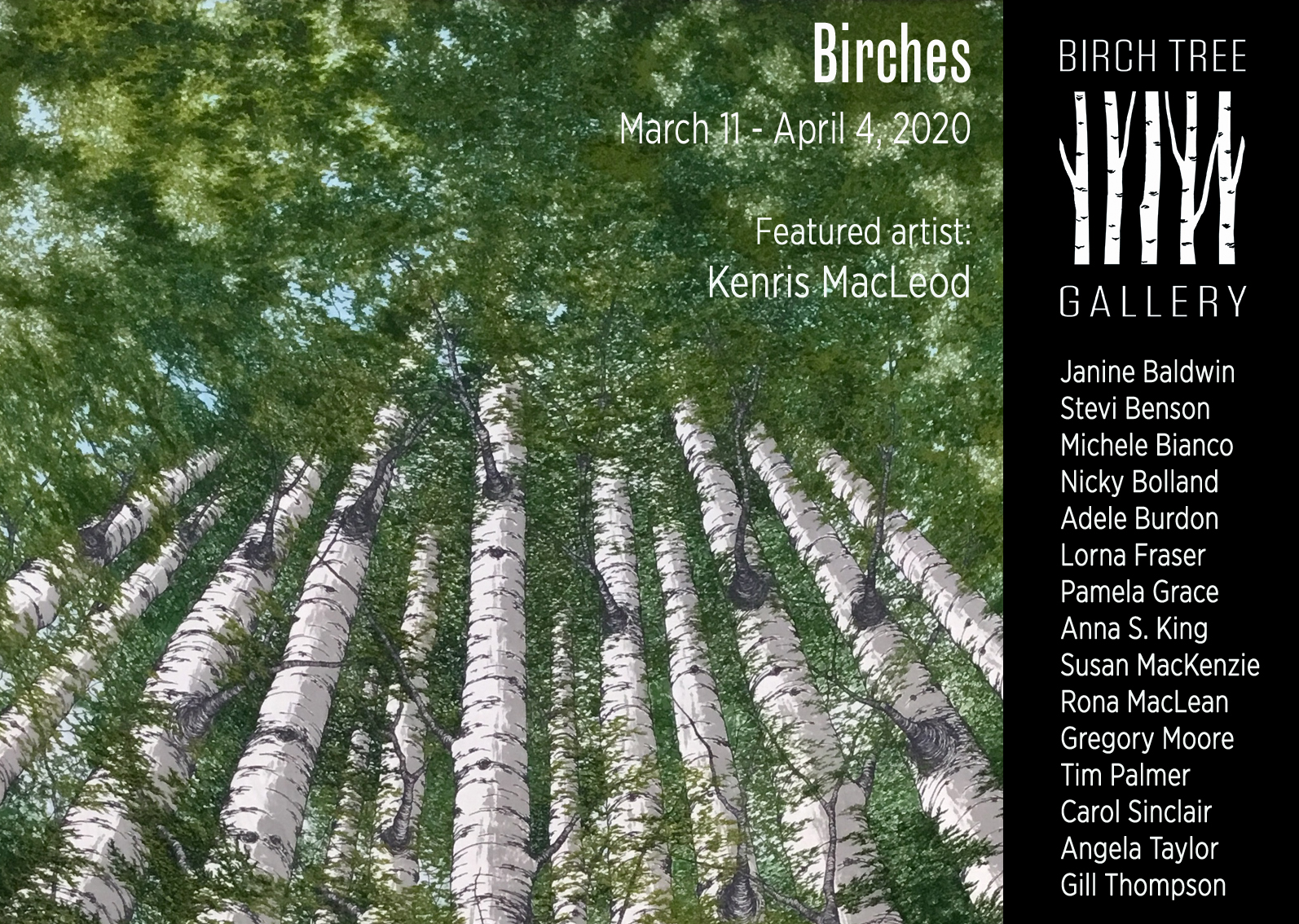
The Birch Tree Gallery is a lovely little art gallery on Dundas Street, which is Edinburgh's 'street of little art galleries'. The current exhibition (showing until 4 April 2020) features art and crafts inspired by birch trees. Beautiful paintings, embroideries, baskets and ceramics fill the small space without cluttering it. 

The gallery is dominated by this large, depiction of birches by Kenris Macleod that features on the poster for the show. Kenris created this piece using free motions machine embroidery - she uses the sewing machine needle to draw and paint with thread.

Birch Tree Gallery - ad Birches (anniversary) 

Take time to look round though and you see a wonderful selection of work, including other works by Kenris Macleod but also collages, vases, baskets of various types. All are inspired by birch trees or the wildlife found in birch woodlands and include depictions of birches in all seasons. 

This exhibion has been curated to celebrate the gallery's third anniversary and features artists who have already exhibited with the gallery, or who will appear in the future shows. 

The owner, Jurgita is very happy to talk about the artworks and is keeping the gallery open for as long as possible, despite the Corona virus. She wants people to feel that they have a nice peaceful space to go and enjoy art. The gallery is rarely busy and there is no need to touch anything other than the door handle which is sanitised regularly. 

You can see the works that are for sale in this exhibition here. 

The next exhibition Printscapes is scheduled to open on 8 April, though will open without a launch event to avoid risks associated with the corona virus. 

You can like the Birch Tree Gallery on Facebook to keep up to date with exhibitions and events.


Wednesday, 17 July 2019

Cut and Paste - 400 Years of Collage

If you're at all interested in collage, Cut and Paste is a wonderful exhibition to see and it won't be touring so you need to catch it in Edinburgh.

Spread over 5 rooms in the Gallery of Modern Art 2 this collection of collage gives a concise, informative and inspiring history of the art form.

The exhibition casts its net wide in its interpretation of collage, including crazy patchwork, decoupaged vases and collections of memorabilia. But the focus is on collage as most widely understood, art made with paper and other items (including buttons, metal and even in one case a starfish) glued onto card or another base.

The original collages were often just accidental, in that the artist added paper to an artwork that had gone wrong and corrected it on the new paper.

Collage really came into its own in the Victorian period with the fashion for scrapbooking, card making and the like. In the 1850s you could buy kits to make your own collages, with all the small pieces required to dress your characters etc. A precursor to the sticker books that are still popular today.

In the Victorian period, collage was almost entirely an amateur pursuit. Later though it developed into a genre of art used by world renowned artists including Picasso and Matisse. It still remains a very accessible, democratic form of art that can be enjoyed by those of us who can't paint or draw with any degree of expertise.

Collage has often been used as an indicator of artistic rebellion, being used by artists to protest wars, repressive regimes and the patriarchy. Pictures on display include a couple of the Merz collages by dissident German artist Kurt Schwitters and Fish Circus by Eileen Agar. Ther are also a couple of videos, including Carolee Schneeman making herself into a living collage with stills of the results of her collage which are protests against the Vietnam War. Add in the priceless reactions of her cat and this is a remarkable video. Towards the end of the exhibition you can see collaged mock ups of the set for Terry Gilliam's brilliant and weird film Brazil.

Cut and Paste is showing until Sunday 27 October at Gallery of Modern Art 2, Belford Road. Full price tickets start at £11. Concessions are available.

The Gallery of Modern Art 1 across the road contains a number of free exhibitions.

When you have experienced enough art for the day, both galleries have fine cafes and both are situated right by the Water of Leith. If you're very lucky (as I was) you will see kingfishers flying around (this is one of their favourite spots along the river).

Thursday, 15 March 2018

Watercolour

There’s something of life in the picture –
dull, dreich mist over storm-dark hills, the lift
of the water as it leaves the canvas,
the peek of light through the foreground
break in the clouds.

I feel wet sand between my toes,
watch eddying rain watering down
shy sunlight, hear the splash of sea
on rocks, the pull of currents.

Wind fresh in my face, drawn into
the scene, I drown in the lake
of a painter’s imagination.


Reposted from May 2006 and previously published on the Sound and Image issue of Online Poetry Journal.  

Meanwhile over on Shapeshifting Green I've reposted another poem from 2006, you can read it here. 

Friday, 15 August 2014

Art in the City


I love these two sculptures by Aliisa Hyslop in the grounds of St Mary's Cathedral in Edinburgh's west end. They move in the breeze and glint in the sunlight. The exhibition is curated by the Arusha Gallery.

Tuesday, 1 April 2014

NaPoWriMo and Malawian Art

blackbird sings
in the skeleton tree -
white mist

 ***

April is NaPoWriMo - national poetry writing month. The idea is to write a poem a day, these poems will by necessity be first drafts, but hopefully can later be developed into more polished works. I'll be  taking part, posting poems both here and on Shapeshifting Green (though not poems on both blogs every day, that would be silly).

Yesterday the NaPoWriMo Early Bird prompt was to write an ekphrastic poem (one inspired by a piece of art) and today on Shapeshifting Green, I've posted a poem inspired by artwork by Jomwa Phiri, an artist I met while I lived in Malawi, who has since become one of the best known artists in that country. I recently found I had more of his paintings than I remembered and have put one in the Crafty Green Poet Etsy shop.

Friday, 20 September 2013

Patchwork Meadow

I was delighted, as a member of Plantlife to be invited today to a presentation from the charity and a viewing of the Patchwork Meadow exhibition.

The Patchwork Meadow project is a public participation artwork involving miniature works of wild flower inspired art, using embroidery, beadwork and applique. People were asked to contribute a 15cm fabric square along with the story of why it was chosen. To date there have been over 800 contributions in the UK and almost two thousand entries from Bulgaria, Croatia, Romania and Slovenia.

Almost 400 squares (mostly from the UK) are on display at the Gallery of the John Hope Visitor Centre of the Royal Botanic Garden Edinburgh.  I was amazed by the sheer variety and beauty of the squares, which demostrate the diversity of our plant life, the wealth of folklore that attaches to these plants and the amazing craft skills of people across these European countries. You can browse the squares at Wildflower Europe.

 The exhibition is free and continues until Monday - so if you're in Edinburgh this weekend why not pop along! The exhibition will later tour the UK, including London, Salisbury and Bangor. (Dates to be confirmed)

The project is open for contributions until January 2014. I have to say that seeing the exhibition today both inspired me (because there are so many amazing squares) but also made me feel that I wouldn't be able to create anything good enough, but still, I'll certainly try!

Wednesday, 14 August 2013

The Planet and Stuff

There are so many grim stories about the environment at the moment, here are just a few:

In Texas some towns are losing their water supplies, because the wells are being drained so the water can be used for fracking.


Half the world's hungry people could survive for a year on the food that G8 countries use as biofuels.

The elephant is loved, revered and respected by people and cultures around the world, yet we're on the brink of poaching these magnificent creatures to exctinction.

The real challenge is knowing how to address these issues without giving in to huge pessimism. I always think that creative projects can do a huge amount to get people involved about thinking about the issues in ways that are empowering rather than depressing.

Polka Theatre recently emailed me about their forthcoming production The Planet and Stuff. Polka Theatre produce world class shows for children and with this production they aim to get children engaged in the issues round climate change. As their own publicity says:

From global inequality to your own recycling. From what’s going on up in the atmosphere to where that sweet wrapper in your pocket came from and where it might end up, climate change takes centre stage.

Part live science demo, part hyperactive game show,The Planet and Stuff  is the fact-packed, straight-talking climate change event with all the answers. What could possibly go wrong?

Friday, 5 April 2013

Art and Science

Yesterday I attended the latest Insights and Ideas meeting, jointly run by Creative Scotland and Museums and Galleries Scotland. The topic this month was Art and Science and the meeting explored ways in which artists and scientists can work together to help communicate science to awider audience and to help bring new insights into science.

Jane Magill of the Scottish branch of the British Science Association talked about projects she has been involved in. She has worked with Kelvingrove Museum and Art Gallery in Glasgow, relating science to the artefacts and paintings in the collection. Projects have included exploring how art works are dated and how they can be conserved. She talked about the Cosmic Way Roadshow which celebrated CTR Wilson, the inventor of the cloud chamber, with an exhibition that toured Scotland from Peebles (Wilson's birthplace) to Fort William, where he did his first experiments. Cloud chambers are not only important scientifically, but the trails of the atomic particles are beautiful to look at. She also talked about the music that was composed specifically for the Cosmic Way Roadshow, which wasinspired directly by the physics involved.

Andrew Ormston of the art science collaboration ASCUS spoke next. He briefly mentioned a lot of projects where artists and scientists are collaborating together, including on an international scale. He focussed on one project that really interested me. Thisis the Grow Wild Project (still a pilot project at the minute), which will encourage people across the UK to plant wildflowers in unexpected places. Artists and creative people will be valuable in this project in helping communicate its aims and in choosing some more unusual places for planting the wildflower seeds.The project will work closely with the Kew Millenium Seed Bank to ensure that the flowers planted suit the local ecology and will offer guidelines to participants to understand enough ecology so that they know where is probably a good place for their wild flowers.

After a coffee break, Ninian Perry of the Paragon Ensemble talked about their project Torque. This interdisciplinary music and dance piece devised by dancers, musicians and scientists uses ideas from renewable energy, inclusive contemporary dance, and sonic arts to create a stimulating theatrical experience. The Ensemble also take ideas from this production into schools, using music and dance to encourage children to think creatively about science.

Finally, Professor Tom Stevenson of the Museum of Communication in Burntisland, Fife, talked about how their collections offer a very thought provoking insight into how communication has changed and how those changes affect our lives.

All in all a very stimulating and inspiring event!

This post also appears on my website. 

As ever, red text contains hyperlinks that take you to other pages where you can find out more.

Monday, 1 April 2013

Spring in the Botanics

We had a lovely walk in Edinburgh Botanic Gardens today. The sun was shining and it was almost mild, though still colder than it would usually be for the time of year.

We particularly liked these flowers though not sure what they are:


This tree has a wonderfully twisted and textured trunk:

and this is one of the lovely views that can be had around the garden:

We had a lovely encounter with a goldcrest, such a tiny little bird and this one was much more tame than is normal, fluttering around for a good few minutes, despite lots of people wandering past. I didn't take a photo, because I wanted to enjoy the moment and my photos wouldn't be able to do justice to the bird!

We also went to the Jalan Jati (Teak Road) exhibition in the Botanics John Hope Gateway. This exhibition traces the wood used to make a 1950s teak bed right back to the area of rainforest it came from. The artwork and photography is stunning and the whole exhibition highlights the usefulness of DNA tracking of raw materials which can help to combat illegal logging. You can find out more about the DNA tracking technology on the Double Helix Tracking website. You can see some of the artworks from the Jalan Jati exhibition on the Migrant Ecologies website.

As ever, red text contains hyperlinks that take you to other websites where you can find out more.

Monday, 11 February 2013

Painted Fish

Here, after many failed attempts is the fish I drew for the Paintafish campaign!


The Paint a Fish campaign aims to engage and educate the younger generations in the protection of fish stocks. People (specially children and young people) from countries in the European Union and beyond are encouraged to paint a fish. All fish will be uploaded on this web site to create a colourful fish stock that will call on EU leaders to refill our seas by restoring fish stocks to their maximum sustainable yield.

The campaign is timed with the final stages of the reform of Common Fisheries Policy which is a once in 10 year opportunity to lay the foundations of sustainable fisheries in Europe.

Another key goal of the campaign is to educate younger generations in sustainable fisheries.

Friday, 8 February 2013

Use your artistic talents to help nature!

I was contacted recently by the Million Trees project, asking if I would spread the word! This project is a fun way to help the environment. You design a tree (or as many trees as you want to design!) and then pay a small amount as a donation to get the tree planted where you want to plant it. It's a project that seems to be very much in the early stages and I have to admit I'm not sure on the details of how it will work, but it's certainly nice to see creative ideas like this.

A similar project is Paint a Fish, which invites people (particularly children and young people) to paint fish, which are then uploaded to a gallery. The gallery will then be used as part of a campaign to persuade the European Union to increase the protection given to European fish stocks. I've been trying to draw a fish, but so far have been too embarrassed by the results to want to share them with anyone, let alone the decision makers of the European Union!. To get an idea though, you can see Caroline Gill's smiling fish. 


Thursday, 6 September 2012

Paradise Restored

Paradise Restored is a beautifully presented, informative exhibition at the Royal Botanic Garden in Edinburgh.

It looks at the work of botanists and conservationists in the Middle East, outlining some of the wonderful landscapes and plants found in the area. It also showcases some of the beautiful crafts of the area.

Paradise Restored is showing in the John Hope Gateway of the Royal Botanic Gardens until 30 September. 

*****

Last year I published The San's Promise by Rethabile Masilo on Bolts of Silk. I'm delighted that the poem was chosen to represent Lesotho in a recent BBC Scotland project to feature poetry from all the countries represented in the Olympics. You can hear Rethabile's poem here, read by Teboho Mohapi.

As ever, red text contains hyperlinks that take you to other pages where you can find out more.

Thursday, 5 April 2012

Cape Farewell and Sadhana Dance

At the Edinburgh International Film Festival last year I watched the inspiring Cape Farewell film Burning Ice, which I reviewed here. At the recent Edinburgh Enlightenment Exchange, Subathra Subramanium talked more about Cape Farewell and I thought I'd do a summary here.
Cape Farewell offers a vital cultural response to climate change by organising voyages to the arctic for artists, scientists and young people to work and learn together. The scientists carry out real science researching the effects of climate change, the artists make pieces of work responding to the landscape, the science and their experiences which they then share with audiences across the world, the young people take part in the science, create their own works of art and when they return home they communicate their experiences to their schools and to other local schools. This is an inspiring and engaging way of getting the message about climate change out to a wide audience.

Subathra also is the artistic director of dance company Sadhana. Their latest project Elixir, an evening of dance, visual art and conversation, explores the vital issue of clean water. This is on tour in the UK until the end of May.

Disclaimer: I was given a press ticket for the Edinburgh Enlightenment Exchange

As ever, red text contains hyperlinks that take you to other webpages where you can find out more.

Wednesday, 4 April 2012

Catalytic Clothes and Invisible Worlds

Today's event at the Edinburgh International Science Festival was Catalytic Clothing. Professor Helen Storey who is an artist and fashion designer at the Centre for Sustainable Fashion at London College of Fashion has worked with polymer chemist Professor Tony Ryan to produce catalytic clothing and clothes conditioners. The idea being that wearing these clothes, or ordinary clothes treated with these conditioners, one can catalyse pollutants into harmless chemicals. The idea is very much still in the early stages and so far has only been rigorously tested with nitric oxide which produces nitrates as an end result. These nitrates then wash out of the clothes and into the water supply, which could be a problem (that being one of the issues still being studied and nitrate run-off from agricultural land being a major issue). There was excellent audience discussion facilitated by Professor John Shephard, which centred on issues such as the need to reduce pollution in the first place and the potential side effects of the clothing. I was very impressed by the openness of Professors Helen Story and Tony Ryan in taking their ideas into the world for discussion at this early stage. Not only is this project a very good example of art and science working together, but also a very good example of open research. Whether it will prove to be a genuine environmental solution remains to be seen, but as a concept it is certainly very exciting!


Earlier in the day I had visited the small exhibition of catalytic jeans and kilts in St Andrews Square.


Luckily by this time the sleet, snow and hail had stopped (although it was still very cold) so I was able to enjoy the wonderful Invisible Worlds exhibition, which includes incredibly beautiful images of microscopic nature and immense galaxies. I'd passed it on the bus several times, but it is definitely worth getting off the bus and having a really good look.


Disclaimer - Clicket gave me a free ticket for the Catalytic Clothes event.


As ever, text in red contains hyperlinks that take you to other webpages where you can find out more.


Tuesday, 31 January 2012

Ghost Orchids by Siobhan Healy

When we visited the Botanics this weekend for the Big Garden Birdwatch, we took a moment to look at this beautiful exhibition by Scottish glass artist Siobhan Healy. The delicate transparent glass flowers in the exhibition are haunting evocations of this very rare flower, the fragility of the medium reflecting the fragility of the plant in the wild.

The ghost orchid was declared extinct in the UK in 2005 but was amazingly rediscovered in 2009!

This exhibition has now closed in Edinburgh, but apparently (and information is contradictory on this) will be on display at the Blaschka Gallery of Glass Flowers at Harvard Museum of Natural History until 4 March 2012. Well worth seeing if you get the chance!

Plantlife, the UK charity for plant conservation has recently put together a Ghost Orchid Declaration outlining the key issues for wild plant conservation and some potential solutions.

Friday, 18 November 2011

Calvet the film released to UK cinemas

Some readers of this blog may remember that I reviewed the Edinburgh International Film Festival this summer. One of the highlights of the festival for me was Calvet, a moving biopic of an amazing artist, Jean Marc Calvet. I'm delighted to hear that Calvet is now being released at selected cinemas across the UK, starting with the Cameo in Edinburgh, at 18.40, Thursday 24 November. You can see the full listing of screenings here. Here is the review I posted back in June: Jean Marc Calvet is a self taught French artist, currently living in Nicaragua. Calvet is a biopic of his amazing lifestory. The film is basically an extended interview with Calvet, interspersed with scenes from the places he has lived, views of his amazing artworks and abstract, impressionistic interludes. Calvet was born in Nice, France, in 1965. He had a hard childhood and an early career as a bodyguard to the stars, a French Legionnaire and a vice cop. He then abandoned his partner and young son to take a shady job in the USA, which led to him absconding to Central America with huge amounts of cash he had stolen from his employer. He hid out in Costa Rica and at one point hid in his house on a coke binge that lasted months. The film gives a brilliant and disturbing recreation of the hallucinatory paranoia he was experiencing at this time. During a particular hallucination he literally found some paint and started throwing it around the house. He realised that this formed a sort of emotional release and he started to paint on a regular basis. At this point he was seeing it as purely a therapy, it was months or years before he began to see himself as an artist. When he had overcome his problems and moved to Nicaragua, Calvet decided to search for his son. I found this part of the film a bit tedious, involving as it did a lot of getting lost in little streets and asking the neighbours if they knew Calvet's family. However, tedious is probably how it felt in reality at times and there is an emotionally satisfying conclusion to Calvet's attempt to reconcile with his first family. Calvet is now married with a daughter and he is a successful and prolific artist. You can find out more about Calvet the film here.  As ever, text in red contains hyperlinks which take you to other webpages where you can find out more.

Thursday, 20 October 2011

Sign Language Poetry

I found out at the last minute about last night's inspiring poetry event at the Talbot Rice Art Gallery. It featured poetry from British Sign Language (BSL) poet Richard Carter. To start with Richard performed some poetry in response to some of the artworks in the intriguing Anton Henning exhibition that was displayed in the gallery. He then performed some poetry from his usual repertoire, some initially without spoken English interpretation.


BSL is a wonderfully expressive language and even without spoken English interpretation, I found it possible to understand the main themes of the poetry. I particularly enjoyed the poem Autumn where books became birds became falling autumn leaves.


After the event, I chatted (through an interpreter) to Richard about imagery in poetry and specifically about haiku. BSL is an ideal language for haiku, with its emphasis on images. In fact BSL haiku are even more pared down and compressed than English language haiku - two BSL signs can convey a haiku very well! There is a BSL haiku website here, where you can find out more and watch some BSL haiku in action.


There is a BSL poetry website forthcoming that should soon be visible here.


As ever, text in red contains hyperlinks which take you to other webpages where you can find out more.