oh dandelions!
if only we could see them
with a rabbit's eyes!
You can read an imagined (and fanciful!) bunny's eye view of dandelions here starring our bunny Anya (now sadly no longer with us).
but not all rabbits are impressed by dandelions, as you can see here on Houseful of Rabbits.
Tuesday, 22 March 2011


Monday, 21 March 2011
Group Birdwatching
This is the last week of the Beginners Birdwatching classes I've been teaching for City of Edinburgh Council Adult Learning programme. I've taught two classes a week and we've had some lovely trips out round Edinburgh. I also taught these classes in the autumn last year. Spring is definitely better for a Beginners Birdwatching class as the birds are chasing each other round and singing their hearts out so they tend to be more obvious than in autumn when they are quieter. Birdwatching classes offer interesting challenges compared to birdwatching alone, e.g.:
* the bird the tutor saw before the class arrived - today for example before the class, I had a lovely view of two goldcrests in a hedge, who didn't show themselves for the group
* the bird that is only seen by half the group - this happens all the time, today some of us saw a brambling and some of us aren't sure whether we did or not
* where is that bird you've seen? see The Hardest part of Birding an entertaining video for the birders amongst us
* describe that bird again? trying to guess the bird that a class member saw that no-one else did from a partial description
* two people looking at different birds but thinking it's the same one and not understanding why the other thinks it's a robin when clearly it's a greenfinch
* we make more noise in a group and so we may scare away the birds or just make too much noise to hear all the birds. Having said that, both groups this term have been very good at walking slowly and quietly and not talking too much.
*************************************
high winds
across the clouds
skylarks sing
* the bird the tutor saw before the class arrived - today for example before the class, I had a lovely view of two goldcrests in a hedge, who didn't show themselves for the group
* the bird that is only seen by half the group - this happens all the time, today some of us saw a brambling and some of us aren't sure whether we did or not
* where is that bird you've seen? see The Hardest part of Birding an entertaining video for the birders amongst us
* describe that bird again? trying to guess the bird that a class member saw that no-one else did from a partial description
* two people looking at different birds but thinking it's the same one and not understanding why the other thinks it's a robin when clearly it's a greenfinch
* we make more noise in a group and so we may scare away the birds or just make too much noise to hear all the birds. Having said that, both groups this term have been very good at walking slowly and quietly and not talking too much.
*************************************
high winds
across the clouds
skylarks sing
Saturday, 19 March 2011
Frogspawn and Birds
We had quite a long walk this morning. we started at Blackford Pond hoping to see frogs and toads. We didn't see any but there was some frogspawn around (see my photo below).

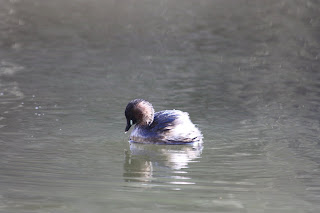
 and this dabchick (little grebe)
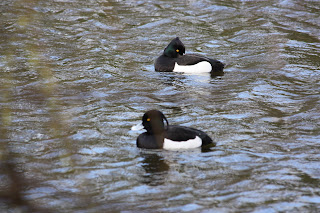
and plenty of tufted ducks.

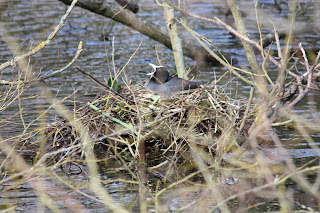
Plenty of birds around too, including this coot, looking slightly bored perhaps on its newly built nest
and this dabchick (little grebe)and plenty of tufted ducks.
(bird photos taken by Crafty Green Boyfriend)
For Nature Notes.
Friday, 18 March 2011
Canalside Reflections


I took these photos 2 weekends ago along the Union Canal, Edinburgh
and on a different note, I've been interviewed over on Robert Frost's Banjo, you can read it here.
Thursday, 17 March 2011
Litter along the Water of Leith
A few days ago I blogged about the Water of Leith Conservation Trust stakeholder conference, which I was delighted to be able to attend as a regular volunteer of the trust. The topic of litter was one that people picked up on in the comments section on that post so I thought I'd say a bit more about that.
The Water of Leith is largely an urban river, passing right through the centre of Edinburgh, ending up at the docks in Leith, which is a very built up area. A fair amount of rubbish gets dumped into the river, some of it intentionally, some of it left behind when people have got drunk and left their beer cans and sandwich wrappers behind, some of it blows into the river from surrounding areas. Some people have developed the habit of bagging their dog's poo but then throwing the bag into the undergrowth or into a tree (which is a disgusting habit!). Some litter gets blown back along the river and walkway from the bins in the area. The council can only supply bins where they can get vehicle access to empty them which means that some stretches of the river don't have many bins.
The river is patrolled by a team of volunteers, who go out once a week, by themselves to look after a specific area of the river. We record wildlife, cut back overgrown vegetation, pick litter and report on major pollution or littering incidents. I usually fill a large carrier bag with litter each week, in the summer it will often be about two large carrier bags. I only pick litter that I can pick without endangering myself - so I don't climb trees, jump into the river or clamber up or down steep slopes.
Around once a month (more in the summer, less in the winter) a volunteer clean-up team takes a length of river which is blighted by litter and spends 2-3 hours in the river and on its banks, filling up a skip with all manner of litter and often some large or strange objects. Many of the clean ups are done by groups from local businesses or community groups. Each year a trophy is awarded to the community group that finds the most unusual item of rubbish, the trophy itself is made from a Victorian figurine that was found in the river!
The Water of Leith is largely an urban river, passing right through the centre of Edinburgh, ending up at the docks in Leith, which is a very built up area. A fair amount of rubbish gets dumped into the river, some of it intentionally, some of it left behind when people have got drunk and left their beer cans and sandwich wrappers behind, some of it blows into the river from surrounding areas. Some people have developed the habit of bagging their dog's poo but then throwing the bag into the undergrowth or into a tree (which is a disgusting habit!). Some litter gets blown back along the river and walkway from the bins in the area. The council can only supply bins where they can get vehicle access to empty them which means that some stretches of the river don't have many bins.
The river is patrolled by a team of volunteers, who go out once a week, by themselves to look after a specific area of the river. We record wildlife, cut back overgrown vegetation, pick litter and report on major pollution or littering incidents. I usually fill a large carrier bag with litter each week, in the summer it will often be about two large carrier bags. I only pick litter that I can pick without endangering myself - so I don't climb trees, jump into the river or clamber up or down steep slopes.
Around once a month (more in the summer, less in the winter) a volunteer clean-up team takes a length of river which is blighted by litter and spends 2-3 hours in the river and on its banks, filling up a skip with all manner of litter and often some large or strange objects. Many of the clean ups are done by groups from local businesses or community groups. Each year a trophy is awarded to the community group that finds the most unusual item of rubbish, the trophy itself is made from a Victorian figurine that was found in the river!
Wednesday, 16 March 2011
Wheelbarrow Farm by Hillary Menos
I was delighted to win a copy of this beautifully produced poetry pamphlet from Templar Poetry who were giving books away for World Book Day on 3 March.
The poems are all set in the 100 acre organic farm which Menos manages and owns. They are vivid evocations of farm life, detailing the issues and difficulties faced by farm workers - including bad weather; injured animals; thistle-filled fields and calf tagging:
The calf you want is always in the far field
with that bullish look in its eye, all beef and brawn
and its mother is always in the near field
with that protective look in her eye, and horns.
.........
calf tagging is considered an extreme sport,
much like ram dagging, and not to be undertaken
without protective work-wear, an ambulance on call
from Belting the Galloways
For those who don't know, Belted Galloways are a Scottish breed of cow. You can read more about them on the Belted Galloway Cattle Society webpage.
These poems take the reader right into the heart of the hard work needed to run a farm. It makes you really appreciate the work behind the food on your plate! (Or not on your plate in this case if you're a vegetarian or vegan).
Wheelbarrow Farm by Hilary Menos, published by Templar Poetry was one of 4 winners of the Templar Poetry Pamphlet Prize in 2010.
As ever, red text contains hyperlinks that take you to other pages, where you can find out more.
The poems are all set in the 100 acre organic farm which Menos manages and owns. They are vivid evocations of farm life, detailing the issues and difficulties faced by farm workers - including bad weather; injured animals; thistle-filled fields and calf tagging:
The calf you want is always in the far field
with that bullish look in its eye, all beef and brawn
and its mother is always in the near field
with that protective look in her eye, and horns.
.........
calf tagging is considered an extreme sport,
much like ram dagging, and not to be undertaken
without protective work-wear, an ambulance on call
from Belting the Galloways
For those who don't know, Belted Galloways are a Scottish breed of cow. You can read more about them on the Belted Galloway Cattle Society webpage.
These poems take the reader right into the heart of the hard work needed to run a farm. It makes you really appreciate the work behind the food on your plate! (Or not on your plate in this case if you're a vegetarian or vegan).
Wheelbarrow Farm by Hilary Menos, published by Templar Poetry was one of 4 winners of the Templar Poetry Pamphlet Prize in 2010.
As ever, red text contains hyperlinks that take you to other pages, where you can find out more.
Tuesday, 15 March 2011
Bolts of Silk
As many readers of this blog know, I edit the online poetry journal Bolts of Silk. In May I will have edited Bolts of Silk for five years. I have enjoyed this immensely and continue to do so. However recently I have started to wonder whether after five years a poetry journal perhaps should seek a new editor? I have seen poetry journals grow tired and stale when edited for too long by the same person and I have seen journals blossom and thrive when they get a new editor after years of stagnation under an overlong editorship.
I don't think Bolts of Silk has got tired, though perhaps I'm too close to it to be able to tell?
What do you think? Does Bolts of Silk need a new editor? Should it look for a new editor as a matter of principle? Any other thoughts? Thanks for your comments!
I don't think Bolts of Silk has got tired, though perhaps I'm too close to it to be able to tell?
What do you think? Does Bolts of Silk need a new editor? Should it look for a new editor as a matter of principle? Any other thoughts? Thanks for your comments!
Subscribe to:
Posts (Atom)