Wednesday, 9 February 2022

The Ravens of the Tower of London - book review

 The Ravenmaster: Life with the Ravens at the Tower of London

  The Ravenmaster by Christopher Skaife 

Subtitled My Life with the Ravens of the Tower of London, this is Skaife's account of acting as the Ravenmaster at the Tower, the man tasked with looking after the birds and making sure that they remain on site, as tradition has it that the UK will fall apart if the ravens ever leave the tower. (There may be some people who think that the UK is currently falling apart despite seven ravens still being at the tower!). 

This is a very entertaining and informative book, written in the same chatty style that I imagine Skaife uses when he give guided tours around the Tower. We learn about the ravens themselves, all of whom have distinct personalities and behavioural quirks (raven Merlina, for example, likes to steal crisps from members of the public!) and Skaife's adventures while looking after the ravens since he became Ravenmaster in 2011.

 The ravens at the Tower are resident there, they're not wild birds, but they have freedom within the Towetr grounds and Skaife ensures they are looked after as well as possible. 

"I strongly believe that if we're going to continue to keep ravens at the Tower we need to make it as welcoming for them as possible, an environment that, if not entirely natural, is at least a place where they have room to roam in safety."

The birds are currently housed in an enclosure that can be locked at night, to keep them safe from foxes and other predators but are able to roam freely around the 18 acres of the Tower grounds during the day. The enclosure was designed by Skaife after close observation of the ravens' behaviour. Their wings are clipped to prevent them flying away, but minimally clipped so that they can fly around within the grounds. 

Skaife also outlines the history of the Tower as a place for animals (it used to be a menagerie containing animals gifted to the monarch); offers a brief overview of the representation of ravens in literature (from Grip the raven in Charles Dickens' Barnaby Rudge to the Simpsons' cartoon interpretation of Edgar Allan Poe's The Raven) as well as looking in some detail at raven intelligence and their social repationships with each other and with humans. 

This is a brilliant book, entertaining and informative for anyone interested in ravens or the history of the Tower of London.

 The Ravenmaster by Christopher Skaife, published ((2018) by Fourth Estate.

 And once you've read this, you'll want to delve more into the history of these specific birds by reading:

 City of Ravens: The Extraordinary History of London, its Tower and Its Famous Ravens

 City of Ravens by Boria Sax

This book looks at the history and myth surrounding ravens, particularly the ravens of the Tower of London and their relationship with the humans around them. During the Industrial Revolution, people tended to demonise the ravens, while nowadays, the ravens are almost seen as national pets. 

Although these days in the UK, ravens are scarce birds, considered as residents of wild remote places (though they breed on the hills of Edinburgh!), in years gone by, they were important urban scavengers and protected for their role in keeping cities clean. However, a bounty was put on ravens in the 16th century and as a result they were hunted, though some breweries kept ravens as mascots. Ravens also have strong symbolic associations, being connected for example to the Norse god Odin and the Biblical prophet Elijah.

One theory as to why ravens were originally kept at the Tower of London was their ability to act as sentinels, calling loudly when they sighted danger. At one point, there was an attempt to use the ravens as a breeding group, giving the Tower a role in conservation of a declining species. There are many myths and legends surrounding the ravens of the Tower, and they have become embedded in British (particularly English) tradition. Interestingly, the ravens are often given to the Tower by rescue centres or similar in Wales, Scotland and Northern Ireland, parts of the UK with strong independence movements.

In this excellent short book, the author examines the true history and the myths surrounding the ravens. He considers whether one day, truly wild ravens will take up residence in the Tower. Finally he examines the question of whether the UK will fall apart of the ravens ever leave the Tower. (Of course, there are those who believe the UK is doing a very good job of falling apart even while the ravens are still in residence.) 

This is  a fascinating read for anyone interested in this particular aspect of UK history and an ideal companion to Ravenmaster.

City of Ravens by Boria Sax, published by Duckworth Overlook (2011).


Tuesday, 8 February 2022

Tree Following February Update

 For Tree Following this year, I've chosen a magnificent old cherry tree in North Merchiston Cemetery in Edinburgh. Crafty Green Boyfriend and I started walking round this cemetery (and the nearby Dalry Cemetery) every day for our #DailyExercise during the first UK lockdown last year. And we're still doing the same walk regularly, though not quite as often. 

Here is a view of the whole tree in winter

And a close up of the buds

The bark of a cherry is quite distinctive, as you may be able to tell if you click on the photo below to enlarge it

Another thing you may notice when you click on the above photo is that there is an area oozing with fluid on the trunk. I'm not sure what this is, perhaps a canker? The tree is very old, and no doubt suffers from various problems. 

In front of the tree, the crocuses are almost in bloom 


and there are a few fungi near the tree too 

And something (badger? fox? dog?) has been digging a hole near the roots 


Monday, 7 February 2022

The giant redwoods of ... Edinburgh!

 I'm continuing my job of carrying out wildlife surveys of all the cemeteries managed by Edinburgh Council. Today, I eventually found Wauchope Burial Ground - coming down Greendykes Road from the main road, you entirely miss it, and it's only when you turn round and go back up the road that you see it. It's a tiny cemetery, originally a family graveyard that was put under Edinburgh City Council management when the owners sold the surrounding land for housing to be built on it. 

This is a tiny green oasis, mostly surrounded by housing 

The family who had originally established this graveyard planted two giant redwood trees (you can see part of one of them on the right-hand side of the photo above and in the photo below). 


I'd heard that tree-creepers like to make roost sites in the soft bark of these trees and sure enough, if you look carefully at the trunk in the photo below, you may be able to see a series of indentations in the bark, which may well be roosting sites for tree-creepers. 


Sadly, I didn't see any tree-creepers during my visit, though I did see a goldcrest (Britain's smallest bird and one whose song sounds very like that of a tree-creeper). 

The grass was scattered with beautiful cones from the redwood trees. so I placed a few on a lichen encrusted gravestone to take some photos


Even more difficult to find than Wauchope Burial Ground is Gogar Cemetery which I (finally) visited on Friday. I had originally tried to get there by bus, but failed totally to find it, as there is no sign of it from the road that is named in its address. I eventually found out that it's very close to the Gogarburn tram stop, but even then it's not immediately obvious and the church is now a cabinet maker's workshop! I don't have photos of this small cemetery, unfortunately.

 For Nature Notes

Saturday, 5 February 2022

Lovely weather for ducks!

 We've had a lot of rain recently, which meant some lovely rainbows the other day

I heard over the past few days that a gadwall had been seen at Blackford Pond. Gadwall are rarely seen in Edinburgh (though sometimes can be seen on the Figgate Pond (see this blogpost)  or at Musselburgh) so Crafty Green Boyfriend and I decided to brave today's rain and visit the pond hoping for a good view. We were very lucky as the male gadwall was swimming around in full view

as was this female gadwall. She looks quite like a slightly smaller female mallard, but her patterning is quite different.

We also met this friendly cat, who was very pleased to find out that Crafty Green Boyfriend was carrying some cat snacks with him!

Thanks to Crafty Green Boyfriend for the photos of the gadwalls.


Wednesday, 2 February 2022

Year of the Tiger

Yesterday marked the beginning of the lunar Year of the Tiger. Since the last year of the tiger in 2010, tiger numbers have increased significantly in some areas, but these big cats have disappeared from other areas. Intense conservation efforts are still essential if we are to ensure that these magnificent creatures survive for future generations to love them. 

Here are some links that are worth reading: 

Mongabay looks at conservation efforts across the world and assesses the best approaches to looking after tigers; 

The Zoological Society of London shares their assessment of the state of tiger conservation, which includes some ideas on how you can get involved; and 

This piece from Wildcats Conservation Alliance focuses on how you can support tiger conservation.

 Securing a Viable Future for the Tiger is a long report by a coalition of conservation organisations. 

Restoring Asia's Roar - World Wildlife Fund looks specifically at the state of tigers in Asia.

**

I shared my poem Year of the Tiger for the last lunar Year of the Tiger in 2010. You can read it here

You can see a tiger themed craft project  from many years ago in this post (I still use this lovely container!)

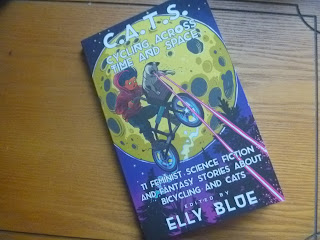
My short story The Tiger's Tale recently appeared in the CATS - Cycling across Time and Space anthology. You can read my review of the book here.

Tuesday, 1 February 2022

CATS Cycling Across Time and Space - book review

"In Space, No-one can hear you meow!"

I'm delighted to have a story in this anthology of feminist science fiction stories about cats and cycling. I really enjoyed reading all the other stories in the collection, all of which fall in the category of speculative fiction, and each of which includes at least one cat and one bicycle, but apart from that, there is a wide variety in theme and style. I've briefly reviewed each story below and can definitely recommend this book for anyone who enjoys short science fiction, particularly if you love cats.

Contents

Myx Sends It by Jessie Kwak, in which a young sphinx learns to fly with the help of a young cyclist. It's a lovely story, and the reader really feels the range of emotions that Myx feels, from her sense of not fitting in to her anxiety about flying to her joy at finally taking wing.

Miss Tompkins Takes a Holiday by Kathleen Jowitt. Miss Tompkins goes on a cycling tour with her cat Aster, who turns out to be very helpful in sorting out a troubling problem. I like the matter of fact telling of this story and the unexpected twist.

Mind the Tiger Plume by Cherise Fong. After a long space flight, a genetically engineered Maine Coon wakes up on Saturn's moon Enceladus which is now dominated by felines. I like the way the main character is shown struggling with and then coming to terms with the new environment.

Sophie by Summer Jewel Keown. Emily takes her cat Sophie to lectures and tries to come to terms with a magical experiment that went wrong. This is a very engaging tale, and I like the way the nature of the failed magic is slowly revealed.

The Ninth Cycle by Gretchin Lair. I thoroughly enjoyed this engaging and entertaining story which focuses on Sage, a Zen master of a cat who helps Whidbey, a young dog, to stop chasing cyclists, and they consider whether dogs can reach enlightenment.

The Certainty of Danger by Monique Cuillierier. Bastet, a telepathic cat, helps out after their human, Lorrin is injured in an earthquake on Mars. Bastet is a wonderful character and the loyal and affectionate relationship between them and Lorrin is very well drawn.

Case Study by Alice 'Huskyteer' Dryden. This is an excellent example of how science fiction can be used in an imaginative way to explore social issues, as a scientist struggles to find out why the cats on an outer planet aren't buying bicycles....

Jetta by Judy Upton in which Erasmus a cat helps Jetta, a security patrol robot to earn about empathy. It's a very touching story about loneliness and the difficulty of finding a real connection.  

The Tiger's Tale by Juliet Wilson is my story of a tiger on her way to Mars in a space ship.

Like a Cat Needs a Bicycle by Kiya Nicoll is a story from an alternative history, starring Audrey, a seamstress and Suffragette and her characterful cat Grimalken, who likes to ride in the pannier of Audrey's bicycle.

Contact in 4, 3, 2 ,1 by Gerri Leen in which Fluffy (not her real name, but the name the humans gave her!) is in command of a spaceship heading for a new world. I like the way this tale of a journey into outer space shows how cats have domesticated humans, not the other way round...

CATS: Cycling Across Time and Space, edited by Elly Blue is available from Microcosm Publishing at this link

I have a few copies available for purchase if you're interested. If you're in the UK and would like a copy of the book (£10 including postage and packing) let me know.

However, if you're in the USA or Canada and would like a copy, please buy from the link above, as the postage will be cheaper (it's shipped from the US)!

If you're elsewhere overseas and would like a copy, let me know, and I'll get back to you about postage costs.


Monday, 24 January 2022

North Leith Cemetery

 I'm continuing to survey the wildlife in all the council managed cemeteries in Edinburgh. Today I visited North Leith Burial Ground, a tiny cemetery

that sits just alongside the Water of Leith

There were a good number of birds around including this friendly feral pigeon 

who later joined with about 30 more feral pigeons alongside the river! 

On the way home, I popped into South Leith Cemetery to check on the squirrels (I blogged here about my survey of South Leith Cemetery, which I carried out in early December). 

I was very glad I had popped into South Leith today, as two of the squirrels were busy making a drey (nest). The photos aren't very clear as I didn't want to get too close and risk worrying the squirrels (though they're used to disturbance as a lot of people walk through this cemetery, many with dogs). Anyway, it was lovely to watch the two squirrels working together, breaking twigs from the tree and carrying them into the drey. If you click on the photo below you'll be able to see a squirrel to the right of the main tree trunk, and you may also be able to see the mess of twigs that is the drey, just to the left of the squirrel.