I've been writing a lot recently, but it's mostly been working on ideas I've already started. Though I've been very productive I've started to feel I'm running out of new ideas for anything longer than haiku (for which i rarely run out of ideas). I've therefore been looking at writing prompts again, even though I'd given up on them for lots of different reasons. Half an hour before writing this post, I saw the latest prompt on Applehouse Poetry Workshop, which was to write a poem about something small and insignificant and start the poem 'Today I want to say something wonderful'. The example given was a poem about a potato peeler and I, perhaps cheating, wrote a poem about my potato peeler. I think though there are lots of general ideas for more poems which could come from this prompt.
In Praise of My Potato Peeler
Today I want to say something wonderful
about my potato peeler
about how it fits as snugly into my left hand
as other people's fit into their right,
how it skims smoothly over the skin
of potato or even, as I prefer my potatoes
scrubbed not peeled, the fresh picked apples
from my in-laws' garden.
Now my apples are smoothly segmented,
rather than roughly gouged and pitted
and the same number of apples
makes a bigger crumble.
And I am transformed from clumsy
into almost a domestic goddess.
As ever, text in red contains hyperlinks which take you to other webpages where you can find out more.
Thursday, 9 June 2011


Wednesday, 8 June 2011
Springwatch
Like many nature lovers in the UK, at this time of the year we are avidly following Springwatch on the TV. It's a great programme, it's accessible for anyone who's just starting to get interested in nature but it's got enough interesting facts in there to keep more serious naturalists happy too. There's also lots of live webcams following different species of birds on their nests (this year the species include grasshopper warbler, oystercatcher and pied flycatcher) with insights into their personal lives, which often rival soap operas for drama and intrigue. It's essential viewing really.
However there is a distinct lack of rabbits on Springwatch. Apart from a brief moment in yesterday's segment of the show from Skomer Island in Wales, where the bunnies were shown next to the puffins (who nest in old bunny burrows), rabbits are usually only seen when they feature as food for some predator.
Well, Charlotte at Cottontails Baby, with the help of her adorable rabbit Humphrey, has put together these wonderful spoof videos to offer an alternative Springwatch with more bunnies. We're promised more too, which I'm really looking forward to!
As ever, text in red contains hyperlinks which take you to other webpages where you can find out more.
However there is a distinct lack of rabbits on Springwatch. Apart from a brief moment in yesterday's segment of the show from Skomer Island in Wales, where the bunnies were shown next to the puffins (who nest in old bunny burrows), rabbits are usually only seen when they feature as food for some predator.
Well, Charlotte at Cottontails Baby, with the help of her adorable rabbit Humphrey, has put together these wonderful spoof videos to offer an alternative Springwatch with more bunnies. We're promised more too, which I'm really looking forward to!
As ever, text in red contains hyperlinks which take you to other webpages where you can find out more.
Tuesday, 7 June 2011
Writing in the Sand by Angus Dunn
This is a brilliant book, engrossing and readable and weaving in conptemororary issues that face Scotland today such as Scottish Independence, land ownership, reintroduction of once native species that have gone extinct and genetic engineering.
The novel is set on the Dark Isle - a fictionalised version of the Black Isle. This is an island populated not only by vivid and memorable human characters but also by a whole range of gods and spirits, who try to push their way into the human world at times of stress.
There are plans afoot to go for a Dark Isle independent of Scotland, and to release the old native species into the isle (including long dead species such as woolly rhinoceros). This is seen by many as messing with nature in the same way that some sensitive characters (this seems to mean most of the inhabitants of the Dark Isle) are aware of the gods' plans to mess with he human world.
The Dark Isle Show is a focal point of the novel, a show that combines agriculture with music and folklore. At the show this year are genetic marvels such as two headed sheep (in fact so many this year that they need a whole new category to themselves) and a musical concert so exciting that it warps the whole fabric of space-time.
This entertaining novel makes the reader laugh out loud while provoking thought into some of the most interesting issues that face today's Scotland.
Writing in the Sand by Angus Dunn published by Luath Press
The novel is set on the Dark Isle - a fictionalised version of the Black Isle. This is an island populated not only by vivid and memorable human characters but also by a whole range of gods and spirits, who try to push their way into the human world at times of stress.
There are plans afoot to go for a Dark Isle independent of Scotland, and to release the old native species into the isle (including long dead species such as woolly rhinoceros). This is seen by many as messing with nature in the same way that some sensitive characters (this seems to mean most of the inhabitants of the Dark Isle) are aware of the gods' plans to mess with he human world.
The Dark Isle Show is a focal point of the novel, a show that combines agriculture with music and folklore. At the show this year are genetic marvels such as two headed sheep (in fact so many this year that they need a whole new category to themselves) and a musical concert so exciting that it warps the whole fabric of space-time.
This entertaining novel makes the reader laugh out loud while provoking thought into some of the most interesting issues that face today's Scotland.
Writing in the Sand by Angus Dunn published by Luath Press
Monday, 6 June 2011
Hidden Meadow
Yesterday, I read Wild Bill's excellent blogpost about Nature's Intersections, and today I was thinking about the natural intersections there are along the Water of Leith. My particular patch of the river is wooded along most of the route, but with some open areas. My favourite open area is that known as the Hidden Meadow, which is found next to the wonderful Redhall Gardens (which will be holding an open day on 26 June so if you're in Edinburgh that day, it would be an ideal day out!).
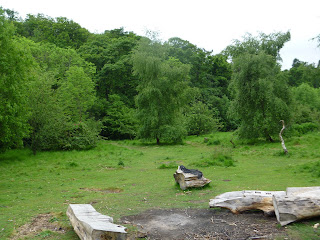
The Hidden Meadow is an open area with scattered trees, mostly apple and birch though with some ash and rowan in there too.

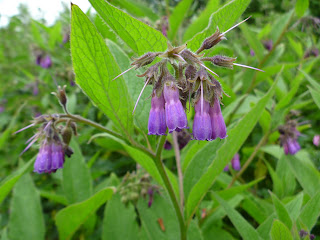
There are a lot of bramble bushes and comfrey grows high and untidy at this time of the year, but is loved by the bees.
 There are some fallen logs in the centre of the Meadow which offer a pleasant place to sit (though this area is often used for barbeques and not everyone is careful when they make barbeques, sometimes I have found lots of litter round here and branches broken from trees too).
In the wooded area along the river, there are lots of blackcaps singing (along with other birds). As you walk into the Hidden Meadow, the blackcaps are replaced, due to habitat preferences, by willow warblers. I love both these birds' songs, but there is something especially magical about the willow warbler's song and as they are a species in decline, it is wonderful to know there is somewhere in Edinburgh where you can be almost guaranteed to hear them.
As ever, red text takes you to another webpage where you can find out more. in the case of birds, that page will include the opportunity to listen to their song!
The Hidden Meadow is an open area with scattered trees, mostly apple and birch though with some ash and rowan in there too.

There are a lot of bramble bushes and comfrey grows high and untidy at this time of the year, but is loved by the bees.
 There are some fallen logs in the centre of the Meadow which offer a pleasant place to sit (though this area is often used for barbeques and not everyone is careful when they make barbeques, sometimes I have found lots of litter round here and branches broken from trees too).
In the wooded area along the river, there are lots of blackcaps singing (along with other birds). As you walk into the Hidden Meadow, the blackcaps are replaced, due to habitat preferences, by willow warblers. I love both these birds' songs, but there is something especially magical about the willow warbler's song and as they are a species in decline, it is wonderful to know there is somewhere in Edinburgh where you can be almost guaranteed to hear them.
As ever, red text takes you to another webpage where you can find out more. in the case of birds, that page will include the opportunity to listen to their song!
for Nature Notes
Sunday, 5 June 2011
Poetry Update
Just to let everyone know that I now have a Paypal account and wherever you are in the world you can now order a signed copy of my chapbook Unthinkable Skies directly from me. The book costs £4.50 and postage is £1.00 within the UK, £1.50 elsewhere in Europe and £2 for the rest of the world. Please leave a comment or email me on Juliet.M.WilsonATgmailDOTcom for more information! Alternatively you can order the book from Calder Wood Press or from Wordpower Books.
The CD of selected poems from Unthinkable Skies with music from Belvedere Mountain Express will be launched on 20 June on CD Baby where it will be available as a download only. You will be able to order a physical CD (including the text of the poems and lovely packaging as seen here) from the Belvedere Mountain Express website.
I have some poems in the Biggar Poetry Garden in the Scottish Borders until the end of August. If you can't get to visit the garden, you can now read the poems here.
And just a reminder that my poetry reading that was scheduled for 11 June has now been postponed until 24 September. More details on that nearer the time.
As ever, text in red takes you to other websites where you can find out more.
The CD of selected poems from Unthinkable Skies with music from Belvedere Mountain Express will be launched on 20 June on CD Baby where it will be available as a download only. You will be able to order a physical CD (including the text of the poems and lovely packaging as seen here) from the Belvedere Mountain Express website.
I have some poems in the Biggar Poetry Garden in the Scottish Borders until the end of August. If you can't get to visit the garden, you can now read the poems here.
And just a reminder that my poetry reading that was scheduled for 11 June has now been postponed until 24 September. More details on that nearer the time.
As ever, text in red takes you to other websites where you can find out more.
Saturday, 4 June 2011
Hermitage of Braid
Today we were at the Meadows Festival, one of the community festivals in Edinburgh that happen before the big festival season gets underway. After yesterday's glorious sunshine, today was dull and cool, but there was good music from local bands, a good selection of Scottish beer and a range of stalls selling locally made crafts, antiques and second hand stuff. Also an entertaining variety of dogs - for the first time there was a dog show (run by the Dogs' Trust), with the doggy dash, though not all participating dogs really did dash, some were rather slow and one sat down halfway through!
Earlier in this week, we had a bank holiday visit to the Hermitage of Braid, a nice wooded area along a stream, called at this stage the Braid Burn though it is known as the Figgate Burn at another point along its length. There were lots of beautiful ferns which made wonderful subjects for shadow shots.
 We also took a different path than usual, which turned out not to really be a serviceable path any more (it was eroded away to a tiny track on the side of a steep slope!), but it did offer us excellent views of the tree planting that is going on in the Hermitage. In areas it looks quite a mess, with the old plantation trees being chopped down (they had been planted too close and the council never made its intended income from them) and new native species being planted to recreate the original woodland. In the photo below, the small green tubes you can see in the clearing are the newly planted trees and the mature trees are the native trees that have been around for a while!
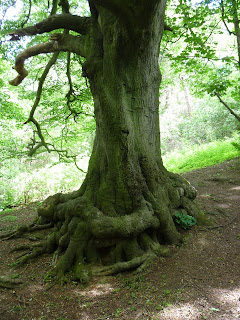
 It will be a few years before some parts of the area look properly like a woodland again, but it will be lovely and overall there's still a lot of mature trees for birds to nest in. Here's one of the old trees in the area, to give an idea of the future for the area.

Earlier in this week, we had a bank holiday visit to the Hermitage of Braid, a nice wooded area along a stream, called at this stage the Braid Burn though it is known as the Figgate Burn at another point along its length. There were lots of beautiful ferns which made wonderful subjects for shadow shots.
 We also took a different path than usual, which turned out not to really be a serviceable path any more (it was eroded away to a tiny track on the side of a steep slope!), but it did offer us excellent views of the tree planting that is going on in the Hermitage. In areas it looks quite a mess, with the old plantation trees being chopped down (they had been planted too close and the council never made its intended income from them) and new native species being planted to recreate the original woodland. In the photo below, the small green tubes you can see in the clearing are the newly planted trees and the mature trees are the native trees that have been around for a while!
 It will be a few years before some parts of the area look properly like a woodland again, but it will be lovely and overall there's still a lot of mature trees for birds to nest in. Here's one of the old trees in the area, to give an idea of the future for the area.
Friday, 3 June 2011
Cucumbers, Metaphors and Death
The news about the e-coli outbreak that may or may not be attributable to cucumbers broke while I was reading Nature and Language: A semiotic study of cucurbits in literature.
Nature and Language: A Semiotic Study of Cucurbits in Literature is a strange book. Published in 1980, it is an entertaining and insightful exploration of the use of members of the curcurbit family (melons, squashes, calabashes, courgettes and cucumbers) as metaphors in literature. It takes a very academic approach to the topic and is full of quotes from literature, in several languages (and not all of them with any type of translation!). The various metaphorical uses of the cucurbits are examined, fecundity, stupidity, fast growth and wider life and death symbolism. It is clear that the authors see the use of cucurbits as metaphors as a special case of nature as metaphor and they explore the bigger picture. They refer repeatedly to the intrinsic humour of cucurbits, due to their size and shape, and the reader can't help but feel that they had their tongues in their cheeks as they wrote much of this book. I have to admit, I've never particularly liked cucumbers and can't eat melons, so my appreciation of some of the metaphors around deliciousness was probably less than the average person's. However it is a fascinating book.
Nature and Language: A Semiotic Study of Cucurbits in Literature is a strange book. Published in 1980, it is an entertaining and insightful exploration of the use of members of the curcurbit family (melons, squashes, calabashes, courgettes and cucumbers) as metaphors in literature. It takes a very academic approach to the topic and is full of quotes from literature, in several languages (and not all of them with any type of translation!). The various metaphorical uses of the cucurbits are examined, fecundity, stupidity, fast growth and wider life and death symbolism. It is clear that the authors see the use of cucurbits as metaphors as a special case of nature as metaphor and they explore the bigger picture. They refer repeatedly to the intrinsic humour of cucurbits, due to their size and shape, and the reader can't help but feel that they had their tongues in their cheeks as they wrote much of this book. I have to admit, I've never particularly liked cucumbers and can't eat melons, so my appreciation of some of the metaphors around deliciousness was probably less than the average person's. However it is a fascinating book.
There seems to be considerable uncertainty over whether Spanish cucumbers are actually the source of the e-coli outbreak, which is mostly affecting people in and connected with northern Germany. (It would be encouraging if this episode could stimulate questions over the sustainability of shipping large amounts of food from one country to another, but that's probably unlikely to happen). One thing that can be certain, is that for the forseeable future, cucumbers now have an added metaphorical significance for many people in Europe and I won't be the only person avoiding eating cucumbers over the next few months.
Nature and Language: A semiotic study of cucurbits in literature by Rolf Norrman and Jon Haarberg published by Routledge and Kegan Paul.
You can read my poem, Death and the Cucumber on Poetry 24 (just click on the link!).
Subscribe to:
Posts (Atom)