Friday, 7 January 2022

Photos from Midmar Paddock and Blackford Pond

A couple of days ago, Crafty Green Boyfriend and I had a walk round Blackford Pond and Midmar Paddock. It was a beautiful day, clear and sunny, though very cold.

The mute swan family on Blackford Pond currently only has five cygnets, the other two have probably gone elsewhere in Edinburgh to join other adolescent swans. I really wanted to get a photo of them all with their heads out of the water, but they were too busy feeding!

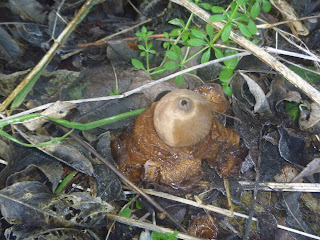
Along the path between Blackford Pond and Midmar Paddock, we were delighted to find some earth star fungi 


Midmar Paddock itself was very frosty 

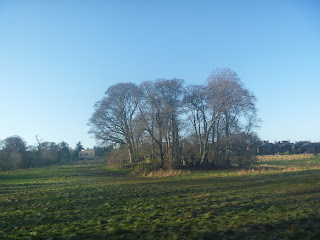
and the views were wonderful in the cold sunshine 


We walked past the trees in the photo above and spent some time watching four grey squirrels, though only three would fit into my photos 


Unfortunately, we weren't alone in watching the squirrels as a dog came along and stalked the squirrels, eventually chasing them up the trees. The dog's owner had wandered off and we couldn't distract the dog. Thankfully it didn't catch any of the squirrels.

For Nature Notes.


Tuesday, 4 January 2022

Some photos from recent walks

 I took time away from blogging and social media over the Christmas period. Crafty Green Boyfriend and I went on some lovely walks and here are some photos from those walks.

We had a lovely walk round Grange Cemetery where we saw a good number of hibernating ladybirds, including this group of two spot ladybirds and pine ladybirds who had found a cosy little spot

 You can see more of my photos from Grange Cemetery here.

We visited Edinburgh Botanic Gardens, where we noticed a good amount of fungi, including this hairy stereum

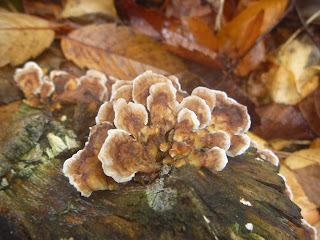
and this purple disc fungus
and we visited Duddingston Cemetery, which I'll blog about separately in the near future, but we were struck by the beauty of the skeleton trees against the moody sky.

Monday, 3 January 2022

Earth to Earth by Stefan Buczacki with illustrations by Felicity Price-Smith


 Earth to Earth is a beautifully produced small book about the wildlife of graveyards in the UK, focussing on English churchyards, but also applicable to cemeteries that are not attached to churches. It's a wonderful celebration of nature in these very special greenspaces, which at the time of publication (2018) were still rarely visited, though lockdown lead a lot of people in the UK to adopt their local cemetery for their #DailyExercise. 

I was particularly pleased to receive this book for Christmas, as I am currently carrying out wildlife surveys of all the council owned cemeteries in Edinburgh.

The book opens with a brief history of burial grounds in the British Isles. Enclosed churchyards first appeared around 1600 which was around the time when gravestones started to become a regular sight in burial grounds. The author then moves on to look at various aspects of the amazing wildlife that can be found in cemeteries.

England has around 10,000 Church of England churchyards, of which around 6,000 are managed specifically for wildlife. (Figures aren't given for churchyards belonging to other denominations or for unattached cemeteries.)

Enclosed cemeteries and churchyards are often wildlife havens, offering a sheltered place where nature can thrive even when urban development covers over much of the surrounding natural habitats. In Norfolk, for example, around half the populations of some of the county's rarest flowers are found in its graveyards. Insects and other invertebrates, such as spiders, are the least understood inhabitants of cemeteries, but the more charismatic wildlife depends on them.  Insects mostly feed on plants, so it is important to maintain the vegetation in a churchyard, not to strip it all back in an attempt to tidy up (admittedly, this is easier in an old churchyard, a graveyard that is still regularly used for burials is much more likely to need to be kept tidy).

Churchyards also offer a wide range of miniature habitats. These habitats include gravestones, which are often colonised by an interesting array of lichens (organisms that are made up of both fungi and algae growing together), many of which are rarely found elsewhere. Many graveyards also include areas of short grass that are not treated with herbicides and so are vital habitats for waxcaps, a beautiful group of fungi, many species of which are rare in the UK. Church buildings are also often home to wildlife, including bats and peregrine falcons.

This book offers not only concise overviews of the various types of wildlife found in graveyards, but offers tips on how best to manage these special places, making the point that 'churchyard management for wildlife is principally about conservation - conserving what is there, rather than trying to create something that is not'. Headstones should be only minimally cleaned for example, to preserve the lichens that often grow on them.

The book mentions several times that graveyards are rarely disturbed, but that is changing since lockdown inspired not only daily walks in the local cemetery but a plethora of Friends Groups, some of which risk, as the book says 'well-meaning but misguided projects and enthusiastic amateurs [which]can cause more harm than good and result in a wilderness rather than a wildlife reserve.'  

The book includes poetry about churchyards, drawings by Felicity Price-Smith and many photos from a variety of people including the author and illustrator.

This beautiful book is a great gift for anyone interested in the nature of churchyards and cemeteries.  It's also an eye-opener for those who think that cemeteries are only places of the dead.

Earth to Earth by Stefan Buczacki, published by Unicorn Publishing

Read the author's essay on churchyard conservation on the website of the Sid Valley Biodiversity Group here.




Tuesday, 21 December 2021

Buccleuch Street Cemetery

I'm continuing my work project of making wildlife surveys of all the council owned cemeteries in Edinburgh. Today I visited Buccleuch Street Cemetery, which lies in the churchyard of Buccleuch Parish Church (Church of Scotland) in the central University area of Edinburgh. Across the road is Buccleuch Street Free Church - you can see both of the churches in the photo below

and just up the road is Edinburgh Central Mosque. 

Buccleuch Street Cemetery must be fairly unique in having a children's climbing frame in the centre of the grounds, in a fenced off area that I can only guess used to be a children's playground!

There's a lot of grass in the cemetery, some of it growing on very gravelly soil. Look closely and you can find fungi, like this turkey tail growing on a dead tree stump

and large amounts of dog lichen (Peltigera sp)

It was very cold while I was doing the survey, so I was very glad to have a flask of coffee with me. When I had a last cup of coffee before leaving the cemetery, a robin flew up onto one of the walls of the cemetery and sang for me! (The European robin is one of the few birds that sings all year round, more unusual still is that the females sing in winter as well as the males! (though this may not be as rare as we've always been led to believe - the Female Birdsong Project, a citizen science project, aims to study female birdsong across the world!).


Monday, 20 December 2021

Wintering by Stephen Rutt

 Wintering by Stephen Rutt

Subtitled 'A Season with Geese' this is a beautifully written account of watching and learning about the various species of wild geese that winter in the UK. The book mostly centres on Dumfries and Galloway, in the south-west of Scotland, an area which Crafty Green Boyfriend and I have visited many times and in fact we have seen many geese while we've been there! 

Rutt's book devotes a chapter to each of the main geese found in the UK - pink footed, barnacle, greylag, brent, white fronted and bean. Each chapter outlines the author's encounters with the particular species, along with notes on how to recognise it and an account of the human history with the species (usually through hunting). 

The book is closely observed, paying attention to the weather and to the wider environment, as well as to the birds themselves. 

"The geese come first as sound. We turn a corner and a muddy channel opens up between two patches of marsh that had earlier appeared seamlessly as one. The wind picks up their calls and the noise drifts over us."

 Wintering by Stephen Rutt published (2019) by Elliot and Thompson.  

 **

Sadly there has recently been an outbreak of avian flu among the geese at the Mersehead bird reserve in Dumfries and Galloway. You can find out more and donate to the emergency appeal of the RSPB (Royal Society for the Protection of Birds) here.


Sunday, 19 December 2021

Winter Photos from North Merchiston Cemetery

 It was very cold this morning as Crafty Green Boyfriend and I walked around North Merchiston Cemetery. The trees looked beautiful in the low winter sunlight, including this magnificent lime tree 

and this row of trees in the distance

I took quite a lot of photos of the beautiful silver birch tree that I'm 'following', I'll save most of those for a final Tree Following update for 2021, but for now here's a spider's web in the branches of that tree. I didn't expect this photo to come out at all, so I'm very pleased with it

We searched for hibernating ladybirds on some of the gravestones and found this group - if you look carefully you can see a cream spot ladybird, a two spot ladybird and a few pine ladybirds


Friday, 17 December 2021

Winter Trees and Impressive Birds along the Water of Leith

 I walked round the Dells alongside the Water of Leith today, doing my weekly patrol of the river. The sun was low in the sky and the trees looked beautiful 


If you click on that last photo to enlarge it, you may be able to see a grey squirrel in the right hand portion of the tree. There were three squirrels running around at the time! 

This buzzard was staying very still (probably looking out for small mammals in the undergrowth) 

and this grey heron was very approachable