Showing posts with label photo. Show all posts

Monday, 13 April 2026

Grey Heron

We had a lovely walk along the Water of Leith on Saturday and were very pleased to see two Grey Herons fishing, surprisingly close to each other. Though not so close we could get them both in the same photo! Here's one of them


Thursday, 18 December 2025

Season's Greetings


Seasons' Greetings to all my readers. 

Happy Christmas to those who celebrate. 

Have a lovely break and see you in the New Year.  

Thursday, 9 October 2025

Insects on Fences

 At this time of year, it's common to see ladybirds gathering together on fences (or gravestones) to hibernate. Yesterday, I was surprised to find a group of hoverfly larvae gathered on a fence post where I would have expected to see ladybirds. (I'm not entirely sure that the green insect in the photo below is a hoverfly larva, but the rest of them certainly are) 

I also wrote about this in yesterday's post on my Crafty Green Substack (with several photos). You can read that article here
 

Monday, 1 September 2025

Robin


autumn sunshine -
the robin's song
changes key 


previously published on Haiku Seeds.  

Monday, 23 December 2024

Tuesday, 9 January 2024

Thursday, 10 August 2023

House Sparrows behaving like Flycatchers

I was leading a birdwatching walk yesterday at Saughton Park today and made sure I arrived early. I spent a nice few minutes standing on this bridge watching a group of House Sparrows flying around and catching insects (probably mostly flying ants, which are around at the moment) in the air above the river. This struck me as fairly unusual behaviour for House Sparrows, I've certainly never seen a group of them doing this together.

I didn't take any more photos during the walk, but we had a nice wander and saw a good variety of birds including: Treecreeper climbing a tree trunk; Greenfinch singing on top of a tree: Goldfinch; Long Tailed Tits (including a large family group); Mallard; Lesser Black Backed Gull; Grey Heron and Robin.

We noticed a lot of gulls flying above the park, possibly feeding on the same flying ants as the House Sparrows.


Friday, 14 July 2023

Thursday, 30 March 2023

Fritillaries

 Not the butterflies, but these lovely flowers that have just appeared in St John's churchyard in Edinburgh (one of our cemeteries that aren't managed by the council (in this case being managed by the Episcopalian church. 


Wednesday, 2 November 2022

Rainbow

 There was a beautiful rainbow here just a while ago. It lasted for quite a while too, which was lovely to see.


Thursday, 24 June 2021

Monday, 19 April 2021

Some flowers grow in unexpected places

 This year the lesser celandines seem to be more magnificent than ever, I feel as though I'm seeing more of them and in more locations than normal, or is this just because I saw so few last year because of lockdown? 

This must be my favourite patch of lesser celandines, growing in the junction of a tree trunk (I should check what species of tree it is too!) in Craiglockart Dell along the Water of Leith.


Celandines have been growing in this tree (and the one next to it) for years! 

Meanwhile, upstream at the other end of the Dells, wood sorrel is just coming into bloom and this is my favourite patch of that flower, growing on a mossy wall 

When you look over the wall, it's amazing how far down the sorrel is growing (though sadly I couldn't get a good photo to show that).


Saturday, 19 December 2020

Dunsapie Loch

 Beautiful sunshine today when we walked up to Dunsapie Loch halfway up Arthurs Seat. Very few birds around though, apart from lots of jackdaws, which were riding the thermals.


Friday, 30 October 2020

Autumnal Red Admiral

 Red Admirals are beautiful butterflies and the species most likely to be seen in Autumn in Scotland. Today we were lucky enough to see two red admirals in North Merchiston Cemetery (part of our Daily Exercise route). Only one allowed a photo, but isn't it lovely?

It was one of many insects enjoying the ivy flowers which are now in bloom (and quite smelly!). There were also several common wasps and at least three species of hoverflies.


Sunday, 2 February 2020

haiku

robinsong -
the first wild garlic pushes
through the soil

**

Delighted to have 2 senryu in the latest issue of Failed Haiku, the senryu journal. You can access the whole issue here

Sunday, 22 December 2019

Seasons Greetings

Seasons Greetings to all readers of this blog.

**

A couple of days ago, our new Christmas tree arrived from Crafty Green Boyfriend's mum. It is in a pot and will be returned to her garden after Christmas. It's the largest we've ever had and I suspect this tree has already spent a Christmas with us.

I decorated it with upcycled decorations, including odd earrings and necklaces from the bags of 'unselleable and broken jewellery' that I like to buy from second hand shops. Plus two bird decorations that I've had since childhood.

Thursday, 28 November 2019

Little threads of civilisation: Unpacking one of Scotland’s greatest road trips

In 1819, engineer, Thomas Telford and Poet Laureate, Robert Southey went on a six-week tour of the Scottish Highlands to inspect the region’s newly built roads, bridges and canals. This became known as one of the greatest road trips of the era and was chronicled in Southey's meticulous journals which were finally published in the 1920s.

At the National Library of Scotland today, landscape architect and historian Paul Daniel Marriott, who's visiting from the US, gave an illustrated talk (Little Threads of Civilisation) about this extraordinary scenic journey. 

The talk started with a photo of the beautiful Dean Bridge, designed by Telford, which spans the Water of Leith and followed the travellers up into the Highlands, including the Parallel Roads at Glen Roy (actually not roads at all, but the marks left by an ice age lake as the water level retreated) which Crafty Green Boyfriend and I had visited during our recent holiday.

Along the way, Marriot spoke about the picturesque school of landscape appreciation (which coincidentally I had just been reading about in Penelope Lively's book Life in the Garden (which I will eventually review on this blog).)

The main purpose of Telford and Southey's trip was to inspect Telford's engineering works in the Highlands, particularly his bridges, his canal locks and his roads. (He seems to have been a particularly prolific engineer). So Marriot talked a lot about roads, which back in 1819 were of course a new technology, enabling people to get around much quicker than they had formerly done and allowing for mail to be delivered speedily. As the traffic was made up of horses and carriages, roads weren't then the polluting problems that so many roads are today (though they had their own problems, not least highway robbers).

It was a fascinating and entertaining talk, as are so many of the talks presented (for free) at the National Library.

**

After the talk, I walked through the Meadows where I met this grey squirrel


Friday, 22 November 2019

National Tree Week 23 November - 1 December


National Tree Week, which starts tomorrow, is the UK's largest annual tree celebration, marking the start of the winter tree planting season. It's an opportunity to celebrate the place of trees in our lives.

The campaign has its roots in the response to Dutch Elm Disease crisis of the 1960s, which wiped out over 20 million of the UK's most significant landscape trees. People joined in to “Plant A Tree in ‘73” and since then, people have planted trees across the country during this week.

Trees are vital to our health and well being. They make our towns and cities more beautiful and offer shade to shelter under on a hot day, while in rural areas they form a vital part of the landscape. They give us oxygen, store carbon, improve air quality, conserve water, preserve soil, support wildlife and help to tackle climate change.

Current official tree planting targets are not ambitious enough.  We need to plant more trees to help reduce UK carbon emissions and prevent climate change from escalating.

However, they need to be the right trees in the right places. If you want to plant a tree in your garden choose a native tree that will not grow too large for the area of your garden. Some types of habitat should not have trees planted on them, peatlands for example are vital carbon sinks in their own right and are habitats for a whole range of rare wildlife and should not be planted with trees. It's also important to realise that natural regeneration is best, so when aiming to expand an existing area of woodland, it may be better to let the trees produce and disperse their own seeds.

Urban trees are vital, as this article in the Guardian explains. In May this year, Edinburgh council leader, Adam McVey, signed up to the tree charter. It will be interesting to see how this affects the city's attitude to trees. Edinburgh has recently suffered a loss of trees due to them being killed and removed in development projects (including work on the new stadium at Meadowbank , 50 trees being destroyed in Princes Street Gardens for disabled access (disabled access is a good thing of course, but whether so many trees needed to be removed is questionable) and the new roundabout at Picardy Place). Meanwhile down in the north of England, Sheffield in Yorkshire has seen loads of its street trees removed as part of a new street maintenance contract.

The Tree Council are asking people to become Tree Champions and plant trees - you can find out more here.

The Woodland Trust offers free trees for schools and community groups, you can find out more here. They also have pages of Tree Planting Advice.

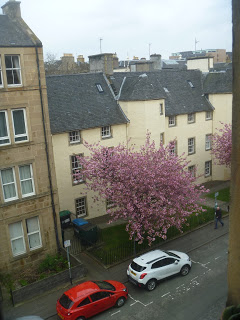
The photos at the top of the article show our local cherry trees in spring and autumn, they are beautiful all year round! 

Thursday, 17 October 2019

Let Nature Sing


European robin, photo by Crafty Green Boyfriend

autumn robinsong -
the leaves a little redder 
than yesterday 

**
The robin is one of the few birds that sing at this time of year. Both male and female robins hold territories and both sing all through the winter. In the breeding season, like other birds, it's only the males that really sing thouh both males and females call to keep in touch with other birds around them.

Today the Royal Society for the Protection of Birds are asking people to join in their 'Let Nature Sing' campaign to help them to bring bird song to five million people. They want bird song to be heard everywhere, from workplaces to living rooms, for people to enjoy and to send a message to people in power we want birdsong to always be heard around us. Find out more here.

Pilton Community Health Project always has birdsong playing in its offices, as it relaxes staff and clients. Is your workplace taking part in Let Nature Sing?

If your workplace tales part and plays birdsong in your office then remember, it's even better to get outside at lunchtime and enjoy nature itself! 


What's your favourite birdsong?