For Tree Following this year I've selected a beautiful horse chestnut tree in one of the cemeteries on our #DailyExercise route.You can see my first blogpost about this tree here.
This is a magnificent tree and its leaves are now fully open as are some of its flowers. But not all of them. It's very noticeable that the candles (that's the name for the groups of flowers) on the south side of the tree are much further on in blooming than the candles on the north.
Here is a candle on the south side of the tree a couple of days ago
and here's one on the north side on the same day
and these are typical. Though oddly the first candle to come fully into bloom was one on the north side, nestled right against the boundary wall of the cemetery.
Here are some more photos of this beautiful tree, taken over the last week or so
For Tree Following.
Friday, 8 May 2020
Thursday, 7 May 2020
The Botany of Desire Michael Pollan

Subtitled A Plant's-Eye View of the World, this book looks at selected plants and their role in human history. The book is arranged into four chapters, each dealing with a different aspect of desire and a different plant:
Chapter 1: Desire - Sweetness; Plant - Apple
Chapter 2: Desire - Beauty; Plant - Tulip
Chapter 3: Desire - Intoxication; Plant - Marijuana
Chapter 4: Desire - Control; Plant - Potato
Each chapter is full of intriguing facts and stories, drawn together into satisfying essays. Along the way we find out the truth about Johnny Appleseed who planted apples across the early states of America, the effects of the war on drugs on the availability and qualities of marijuana, the Amsterdam tulip fever of the 1630s and genetic engineering.
Pollan uses these familiar species to show how these plants have evolved to satisfy human desires. These plants though, have also done well out of their relationship with humans, in terms of being propogated across the world. So who is really domesticating whom?
Pollan is a fine writer and the book is engrossing and beautifully written.
The Botany of Desire by Michael Pollan published by Random House.
Wednesday, 6 May 2020
Highlights of Recent #DailyExercise Walks
We continue to take our #DailyExercise walks through the local park and two cemeteries. Here are some highlights from recent walks.
The coltsfoot flowers are over now and have formed seed heads, which are beautiful. Here they are on a recent rainy day
and here they are yesterday in the sunshine, looking like they've been blown dry, which they have really!
This nest had fallen out of a tree in one of the cemeteries, I don't know what type of bird had built it, but hopefully whatever it was has time to build another nest and raise a family
We continue to find a wealth of insect life in the cemeteries particularly, including this magnificent green longhorn moth
and this pine ladybird, one of three we saw, but there must be more of them around
The small toirtoiseshell and peacock butterflies that were so prevalent a couple of weeks ago have mostly disappeared, but we're seeign good numbers of orange tips (which don't want to pose for the camera) and the occasional comma
(The metamorphosis of caterpillars into moths and butterflies is fascinating and Discover Wildlife recently posted an excellent short article on this process, which you can read here).
Both graveyards host lots of hoverflies, such as this Helophilus hybridus
We saw our first swift of the year yesterday (read yesterday's post for more about these wonderful birds).
For Nature Notes.
The coltsfoot flowers are over now and have formed seed heads, which are beautiful. Here they are on a recent rainy day
and here they are yesterday in the sunshine, looking like they've been blown dry, which they have really!
This nest had fallen out of a tree in one of the cemeteries, I don't know what type of bird had built it, but hopefully whatever it was has time to build another nest and raise a family
We continue to find a wealth of insect life in the cemeteries particularly, including this magnificent green longhorn moth
and this pine ladybird, one of three we saw, but there must be more of them around
The small toirtoiseshell and peacock butterflies that were so prevalent a couple of weeks ago have mostly disappeared, but we're seeign good numbers of orange tips (which don't want to pose for the camera) and the occasional comma
(The metamorphosis of caterpillars into moths and butterflies is fascinating and Discover Wildlife recently posted an excellent short article on this process, which you can read here).
Both graveyards host lots of hoverflies, such as this Helophilus hybridus
We saw our first swift of the year yesterday (read yesterday's post for more about these wonderful birds).
For Nature Notes.
Thinking about:
#dailyexercise,
In and around Edinburgh,
nature diary,
photos,
Spring
Tuesday, 5 May 2020
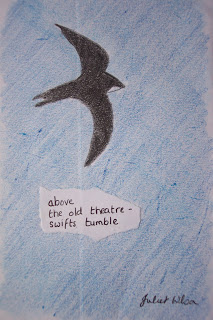
First Swift of 2020
Do you see the swifts are here again?
They swoop so low and soar so high
I think there may be more than ten -
do you see the swifts are here again?
We know it's summer round here when
our favourite bird comes gliding by
You see the swifts are here! Again
they sweep so low and soar so high!
**
I saw my first swift of the year today! Not from our living room window as I would expect (we live near a good number of swift nests) but while we were walking round one of the local cemeteries on our #DailyExercise walk. This is a few days earlier than the first sighting last year! Hopefully soon these wonderful birds will once again be flying round our building!
Swifts only visit Scotland for just over three months in the year (May to August) and spend the rest of the year flying down to Africa and then round and round Africa before coming back to the same nest site. They only land when they're nesting, when the young leave the nest they remain airborne for three or four years before they make their first nest! Swifts are declining in the UK for a number of reasons but one is the lack of nest sites - they nest in holes in walls and under roofs and these days these holes are often blocked up when buildings are renovated. The City of Edinburgh Council (and some other councils in the UK) advise that swift bricks be used in new buildings over a certain height (a swift brick is a brick that is hollow inside and includes an entrance hole so that the swifts can enter the nest) but they can't enforce this.
Some links about swifts
Swift starter kits and how adding ‘nest forms’ to swift boxes makes common swifts more than four times more likely to use the boxes - read more on Mark Avery's blog here.
Celebrating swifts with the RSPB here.
Instructions on how to make a nest box for swifts from the RSPB here.
A very impressive example of swift nestboxes installed in industrial buildings in the Netherlands. The article is in Dutch, but the photos are worth looking at, even if you don't understand Dutch.
My poem 'Waiting for Swifts' has now been published by Poetry Kit as part of their 'Poetry of the Plague Year'. You can read it here.
Thinking about:
#dailyexercise,
birds,
nature diary,
poetry
Sunday, 3 May 2020
Up Close with Trees
Tree Following asks us to focus on just one individual tree but there are so many beautiful trees in the cemeteries on our #DailyExercise route that I can't resist taking photos of them.
Here are some photos of the trunk of one old silvre birch tree
Here are close ups of the fruits of one elm tree
and close ups of a sycamore tree coming into bloom
What trees can you see from your window or in your garden or on your #DailyExercise walk?
Here are some photos of the trunk of one old silvre birch tree
Here are close ups of the fruits of one elm tree
and close ups of a sycamore tree coming into bloom
What trees can you see from your window or in your garden or on your #DailyExercise walk?
Thinking about:
#dailyexercise,
photos,
Spring,
treefollowing
Saturday, 2 May 2020
Flowers in Bloom and some interesting insects
We continue our #DailyExercise walks round a local park and 2 cemeteries.
We were delighted to see ramsons (wild garlic) coming into bloom in one of the cemeteries, these phots are from a couple of days ago:
We were actually quite surprised to find this, as there is quite a lot of few flowered leek in this cemetery, which is an invasive species that tends to push out wild garlic. At the moment though the leeks haven't invaded the area where these ramsons are.
I always like the combination of blue and yellow and here the dandelions look lovely with the bluebells (these aren't native bluebells, but hybrids with the Spanish bluebell, so they're sturdier than our native species and don't have the beautiful fragrance.)
Sone of the dandelions have already gone to seed, their seedheads are beautiful too
Interesting insects that we#ve seen over the past few days include this rove beetle
and this shieldbug, which I think is a hawthorn shieldbug
We were delighted to see ramsons (wild garlic) coming into bloom in one of the cemeteries, these phots are from a couple of days ago:
We were actually quite surprised to find this, as there is quite a lot of few flowered leek in this cemetery, which is an invasive species that tends to push out wild garlic. At the moment though the leeks haven't invaded the area where these ramsons are.
I always like the combination of blue and yellow and here the dandelions look lovely with the bluebells (these aren't native bluebells, but hybrids with the Spanish bluebell, so they're sturdier than our native species and don't have the beautiful fragrance.)
Sone of the dandelions have already gone to seed, their seedheads are beautiful too
Interesting insects that we#ve seen over the past few days include this rove beetle
and this shieldbug, which I think is a hawthorn shieldbug
Friday, 1 May 2020
Tree Following and Walk Where you May - a horse chestnut in a cemetery
It's six years now since I first heard about Tree Following and decided to follow a larch tree in Craiglockart Dell. Click here to see my blogpost about the development of the larch cones from beautiful red flower to mature cone.
This year I decided (belatedly) to join in again. Unfortunately the lockdown for coronavirus means that Craiglockart Dell is too far away for me to visit on our #DailyExercise, which must be a local walk. So I have chosen a horse chestnut tree in one of the local cemeteries to follow.
On 25 March, the leaves were just starting to emerge:
these next few photos show the buds as they progressed over the next week or so
Here is the point where the old leaf has fallen off leaving a scar that looks a bit like a horse shoe, which may be how the tree got its name.
Looking up into the canopy
and a shot of the trunk
This tree is home to some interesting insects including this ten spot ladybird:
Thanks to Squirrel Basket for hosting this year's Tree Following. You can find out more and take part here.
Walk this May, the annual walking campaign has rebranded itself during lockdown as WalkWhereYouMay and the Tree Council are asking people to use their walks to study one particular tree that they encounter on the way. Find out more here.
This year I decided (belatedly) to join in again. Unfortunately the lockdown for coronavirus means that Craiglockart Dell is too far away for me to visit on our #DailyExercise, which must be a local walk. So I have chosen a horse chestnut tree in one of the local cemeteries to follow.
On 25 March, the leaves were just starting to emerge:
these next few photos show the buds as they progressed over the next week or so
(28 March)
1 April (above and below)
4 April
5 April
6 April
8 April
16 April
26 April
On the 30 April, I took these three photos to show how varied the flower candles are in terms of their development - all on the same tree:
Looking up into the canopy
and a shot of the trunk
This tree is home to some interesting insects including this ten spot ladybird:
Thanks to Squirrel Basket for hosting this year's Tree Following. You can find out more and take part here.
Walk this May, the annual walking campaign has rebranded itself during lockdown as WalkWhereYouMay and the Tree Council are asking people to use their walks to study one particular tree that they encounter on the way. Find out more here.
Thinking about:
#dailyexercise,
nature diary,
photos,
treefollowing
Subscribe to:
Posts (Atom)