rushing river -
the stillness
of the grey heron
**
previously published in Haiku Corner 41 of the Japan Society UK.
rushing river -
the stillness
of the grey heron
**
previously published in Haiku Corner 41 of the Japan Society UK.

This is a beautiful book full of stunning illustrations and fascinating essays about twenty-two astonishing and endangered animals, including the wombat, the swift, the hermit crab, the narwhal and of course the golden mole.
In the introduction, Rundell exhorts us to "look, only look at what is here, and would you agree to astonishment and to love? For love, allied to attention, will be urgently needed in the years to come."
The details shared for each species (or closely allied group of species) certainly inspire curiosity, wonder and affection for each animal. There are Greenland Sharks in the ocean that have probably been alive for over six centuries, a female may take 150 years to reach breeding age.
Swifts are the only birds to mate in mid-air, they also fly through rain showers with wings outstretched to get themselves clean. Swifts need to catch as many as a hundred thousand airborne insects a day, which means they are acutely sensitive to the current reduction in insect numbers that is happening across the world.
Elephants may 'bury dead members of their herd, covering them in earth and brightly coloured leaves, working together, surrounding the corpse with fruit and flowers'.
There are intriguing stories here about how species interact with humans, including the crows that brought gifts to a girl who had been feeding them since she was five and one day returned her camera lens cap to her after she had lost it on a walk. Meanwhile, Rooks (also in the Corvid family) have been trained in some places to pick up litter in return for food.
Storks inspired the early aviators and in 1822, an individual with an African spear through its neck arrived in Germany, proving that birds actually migrated (rather than spending the winter at the bottom of a lake or on the moon, as had earlier been thought).
Folklore features here too, such as the Hawai'ian belief that the ʻalalā (another species of Corvid) is a guardian of the soul. A soul needs to meet a guardian ʻalalā so they can jump into the afterlife together. The bird is now extinct in the wild and attempts to reintroduce it have been beset with problems. If this bird cannot be saved, then 'one of the ways in which humans have painstakingly and generously explained death to each other will be dead and there will be no guides awaiting the souls'
Rundell also shares the many ways in which humans are driving these creatures to extinction, including overfishing of tuna, hunting elephants and pangolins, while "noise pollution risks rendering [narwhals] inaudible and effectively mute, thereby unable to protect and teach their young - we have taken their silence and replaced it with a nightclub roar."
The golden mole, which isn't actually a mole, is the only iridescent mammal: "under different lights and from different angles, their fur shifts through turquoise, navy, purple, gold....... but the golden mole is blind... unaware of [its] beauty, unknowingly glowing."
This is a book to treasure, along with all the wonderful unique lifeforms described in its pages.
I have a copy of the hardback which was published in 2022, but it is now also available in paperback.
The Golden Mole by Katherine Rundell, illustrated by Talya Baldwin, published (2022 in hardback) by Faber.
It was freezing cold this morning, but the sky was bright blue and there were signs of Spring everywhere. I was doing my regular patrol of the Dells alongside the Water of Leith. I'm not picking litter at the moment (taking it easy after my recent cataract surgery) but there was plenty to do recording all the wildlife.
This little path is always a delight during late Winter and early Spring. The snowdrops are already in full bloom and the daffodils are starting to open

In another part of the Dells, crocuses are in full bloom


Yesterday we went to Linlithgow, primarily to walk round the Loch

There seemed to be a lot of Robins about and some of them were very bold - this one sang beautifully for us:

We saw a group of Bullfinches - three females and two males, the bird below is a male:

There were plenty of birds on the Loch as well. As well as the Great Crested Grebes we saw a good number of Mute Swans:

Several Coots

a Grey Heron hunting for frogs

and (particularly lovely to see) a Kingfisher that didn't really want to have its photo taken


On the water, we also saw: Tufted Ducks, Mallards, |Goldeneye, Goosanders, a Little Grebe and Cormorants (some of which can be seen below hanging on branches with their wings outstretched to dry them)

**
I was very pleased to find my poem 'A Landscape Viewed through Cataracts' in the responses to the painting Green Terrain, by Kelly Austin-Rolo on the Ekphrastic Review website. You can read all the responses here.
It's World Gaelic Week, so I thought I'd try and find out more about the Gaelic Tree alphabet. The Gaelic alphabet has only 18 letters (which is probably one of the reasons the spelling of the language can seem so difficult to a non-native speaker). Each letter is paired with a tree. This evolved from the earlier Ogham alphabet, which was used to write the old Irish language.
The Gaelic Tree Alphabet is:
A for Ailm (Elm)
B for Beith (Birch)
C for Coll (Hazel)
D for Dair (Oak)
E for Eadha (Aspen)
F for Fearna (Alder)
G for Gort (Ivy)
H for Huath (Hawthorn)
I for Iogh (Ivy)
L for Luis (Rowan)
M for Muin (Bramble)
N for Nuin (Ash)
O for Onn (Gorse)
P for Peith Bhog (Downy Birch)
R for Ruis (Elder)
S for Suil (Willow)
T for Teine (Holly)
U for Ur (Heather)
Though some plants also have other names, for example Froach also means heather.
There is an excellent resource on the trees of the Gaelic Tree alphabet on the An Darach website.
If you're interested in finding out more about the old Ogham alphabet, there seem to be a lot of web resources out there, including this guide on Wikipedia.
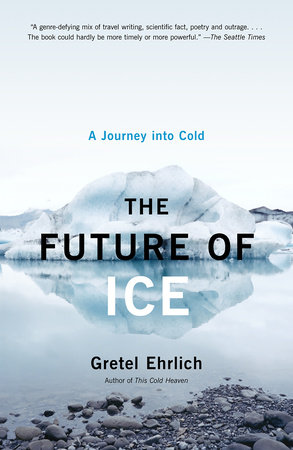
In The Future of Ice, Gretel Ehrlich travels across the world, from her home in Wyoming to the Arctic, to look at winter landscapes and to consider how climate change is damaging our landscapes and the whole idea of winter.
It's a book packed full of lyrical descriptions, punctuated by snippets of her personal life and snippets about climate science and the science of glaciers:
"A glacier is an archivist and historian. It saves everything no matter how small or big, including pollen, dust, heavy metals, bugs, bones and minerals. It registers every fluctuation of weather. A glacier is time incarnate, a moving image of time. When we lose a glacier - and we are losing most of them - we lose history, an eye into the past; we love stories of how living beings evolved, how weather vacillated, why plants and animals died. The retreat and disappearance of glaciers - there are only 160, 000 left - means we're burning libraries and damaging the planet, possibly beyond repair."
I found the book to be rather overloaded with lyrical descriptions. I enjoy beautiful descriptions, but here I felt they sometimes lacked substance.
The Future of Ice by Gretel Ehrlich, published (2004) by Penguin Random House.
It's World Gaelic Week (Seachdain na Gàidhlig) which aims to raise the profile of Gaelic through community initiatives, projects and events.
Scottish Gaelic is familiar to many people living in Scotland through place names, particularly in the Highlands. It is also a living language for people in parts of Western Scotland, particularly the Western Isles (the only part of the country where televised election results are read out in Gaelic as well as English).
I've been learning Gaelic for about a year now, and it's an interesting language, very different to English in spelling and grammar so it feels tricky to learn (though it is no more intrinsically difficult than any other language).
I'm particularly interested in Gaelic words relating to the natural world, not just place names, but also Gaelic names for plants and animals.
Here's a nice article on the NatureScot (formerly Scottish Natural Heritage) website about the Gaelic names of birds. I particularly like the fact that one of the Gaelic names for the Dunlin is gille-feadaig, meaning ‘servant of the plover' as the smaller wader will often be found hanging out with plovers.
NatureScot also has a useful looking dictionary of Gaelic words relating to nature.
And National Theatre of Scotland have produced a short film about language based on the play Somersaults by playwright Iain Finlay Macleod.
A poetic exploration of language and how it defines who we are, captured on the Isle of Lewis. You can watch it here.
If you're still on Twitter, if you search for World Gaelic Week you'll find a good number of nature organisations sharing nature words from Gaelic.