Wednesday, 6 September 2023

Blackford Hill and Pond

 Today was the third day of our staycation in Edinburgh, and we had arranged to spend the day separately (apart from lunch) each of us spending time with various friends. This afternoon, a friend and I climbed Blackford Hill. I had first walked past Blackford Pond 


walking along this shady path 

I was pleased to see several butterflies, though the Red Admirals evaded my camera, I did manage to capture this Speckled Wood 

We then walked up the hill, which has some magnificent views across Edinburgh to Arthur's Seat 

and a good close view of the Agassiz Rock. 


In 1840, the Swiss Geologist Louis Agassiz, found evidence at this volcanic outcrop that ice had once covered the landscape, in this case leaving horizontal scratch marks on the rock surface. This lead to further research to uncover more evidence that parts of Britain had indeed been ice covered in past times.

Tuesday, 5 September 2023

North Berwick

For the second day of our staycation in Edinburgh, we caught the train to the coastal town of North Berwick. We wanted to catch some sea breezes to cool down as the weather is so unseasonably hot at the moment. And the bach at North Berwick is beautiful.

Views towards the harbour at North Berwick are dominated by the Bass Rock, which is a huge gannet colony. Although avian flu is decimating seabird populations across Scotland, gannets are not being as badly affected as many bird species. Large numbers of gannets now have black eyes, instead of blue, after having survived bird flu (read more about this on the RSPB website here). From a distance, the Bass Rock is still white from the many gannets. 

There are quite a lot of small islands off the coast here 

and the beach is beautiful

A lovely place for a late summer walk.

We also, for the first time, visited the old St Andrew's Church, now a ruin. 

In the photo below, you can see the current St Andrew's Church in the background.
 You can read a little about the history of the three St Andrew's churches of the town here.

We were also impressed by this floral display near the railway station, which is maintained by North Berwick in Bloom.


Monday, 4 September 2023

Easter Craiglockart Hill

 We're off work this week and having a staycation in Edinburgh! The weather is beautiful (though possibly too hot to be honest). Today, we had a lovely walk around Easter Craiglockart Hill.

The hill has lovely views across Edinburgh

The steps in the photo below were built a year or so ago and have made a real difference to the accessibility of the hill and protect the ground from excessive erosion.

We saw a good number of Speckled Wood Butterflies (see if you can spot one in the photo below!) 

It was lovely to see Harebells growing on the hill

Crafty Green Boyfriend took some close-ups of these lovely flowers


We walked through the orchard near the Craighouse development. This development has caused much controversy, though this seems to have died down and the developers seem to be sticking to their word of preserving both the historical buildings (which used to be a psychiatric hospital and then was used by Napier University before being sold to developers - you can read more about the history of Craighouse here)


and much of the greenspace, the orchard is certainly lovely 


and there are beautiful views across to Arthur's Seat 


Sunday, 3 September 2023

Corstorphine Hill

We had a lovely walk round Corstorphine Hill yesterday, in warm sunny weather. 

Speckled Wood Butterflies were flying around everywhere, though this is the only one that stayed still enough for a photo (click on the photo to enlarge the image)

We walked to the top of the hill, where the Corstorphine Tower was built as a memorial to Sir Walter Scott (you can read more about the tower here). 

Near the tower is this magnificent Scots Pine tree 

Signs of autumn are starting to show, including the presence of galls on some of the oak trees, including these Knopper Galls, which are caused by the knopper gall wasp (Andricus quercuscalicis). The gall starts off quite small on the top of the acorn,

but then grows


and grows until it takes over the entire acorn. There can be a lot of Knopper Galls on the same tree. 


You can read more about Knopper Gall wasps on the Woodland Trust website.

Friday, 1 September 2023

Second hand September - what really happens to clothes donated to charity?

This month is Second Hand September, a chance to highlight the value of buying second hand, focussing on clothing. When you shop second hand and donate unwanted clothes to second hand shops, you reduce waste, take a stylish stance against climate change, and help create a fairer world.

However, only as little as 20% of donations may end up getting sold in the shop. Many donations end up in countries in the global south, where there is big trade in second-hand clothing. Once in those countries, again there is no guarantee that the items will be sold, and mountains of unwanted clothing litter places from the Atacama Desert to rubbish dumps in Africa. 

This article, on the Guardian newspaper website, highlights how creative entrepreneurs across the world are using waste clothing to create their own highly sought after products, including children's toys, home textiles and shoes. 

The African country of Ghana imports around 15m items of second-hand clothing each week - read more in this article on the Guardian website.

Buying second hand is of course good, because you are genuinely reducing waste by re-using things. Donating is also good for the same reason. The problem lies in what happens in between. Many people buy clothing and wear an item only once for a party or for a photo to share on social media. Then these items are donated to charity, or even worse, thrown away. To make things worse, many clothes these days are poorly made and don't last long, even if you wanted to wear the same item to several parties or a whole series of social media posts.

So, even better than buying only second hand clothing this month, can you actually go all month without buying any clothing? And if you do need to buy new clothes, buy fewer items and make sure they're good quality. And think about how to make your clothing last longer: 

If your shoes get worn down, can they be repaired? (There aren't so many cobblers around these days, but if you can find one, use their services and make your footwear last longer). 

If a button falls off, sew it back on.

If a zip fails, replace it if you can or get a local repair shop to replace it (there may well be more clothing repair shops now than there used to be, there are certainly several in Edinburgh). 

If an item rips, consider creative ways of patching it up. 

If an item no longer fits, can you alter it, so it does fit? (Again, either do this yourself or take it to a clothing repair shop). If you can't alter it, and it's still in good condition, then donate it to charity.

If an item is no longer in good enough condition to wear out, where it around the house until it falls apart, and then use the cloth as rags.

How about upcycling fabrics? Here is a tweet from Oxfam (one of the UK charities that has a lot of second hand shops) showing how one of their volunteers upcycles fabrics into clothing.

The Or Foundation (Strap-line "Too much clothing. Too little justice") is a charity that works in Ghana and the USA to campaign on reducing clothing waste and move towards a circular economy.

**

Second Hand September is all about celebrating second hand clothing! Can you commit, for the whole month, to buying only second hand clothes? And don't forget to donate your pre-loved items! Find out more about Second Hand September here and sign up to take part here.  

**

If you're interested in issues around clothing, you may be interested in the thought-provoking Fashioning the Future report from the War on Want charity 

Remember, click on the coloured text to go to other websites where you can find out more!


Tuesday, 29 August 2023

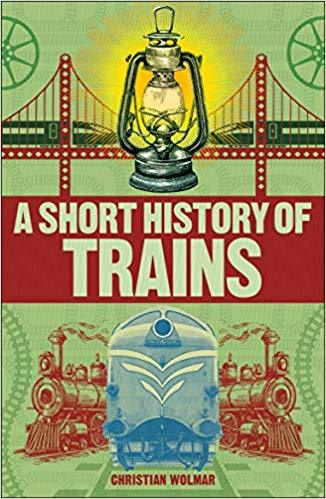
A Short History of Trains by Christian Wolmar


Trains offer a great way to travel, as they are generally the safest and most environmentally friendly mode of transport. I also have a fondness for trains, due to two personal connections. My great-grandfather, Mr Train was a station-master (his son Mr Train junior married a Miss Driver, thankfully they didn't take a double barrelled name!). Additionally, I was born in Manchester, which was host to the world's first major railway line, the Liverpool to Manchester line which opened in 1830. So, all in all, this book was a must-read for me. 

A Short History of Trains is a fascinating history of trains and railways, from the first steam engines to the most technologically advanced, high-speed trains of today. The book is packed full of interesting facts and anecdotes, historical photos and diagrams. There are a few pages of illustrations of different styles of railway carriages, and important statistics are scattered through the book.

The book looks at the history of the first railways in various parts of the world. The construction of these railroads met with difficult terrain, tough working conditions and often resistance from local people who lived on the land the railways were to be built across. I was struck by this anecdote about the development of early lines in the USA:

The local tribe demanded $10,000 dollars (around £185, 000 in today's money) for the right of way. Appalled, the railroad works manager blustered that the land was no good for anything else apart from growing corn or potatoes. The local chief responded 'it pretty good for railroad' and got the money. 

We are also told about the dark history of the inhumane treatment of prisoners of war who built the Burma to Siam (now Thailand) railway and the role railroads played in Nazi atrocities.  

 The book also looks at how railroads impacted communities, bringing more people into an area and stimulating the local economy. In addition, as it became easier for people to travel between areas, then they could move around for work, spread ideas and meet a greater variety of people.  It considers the changing fortunes of trains as they competed with the introduction of cars, then the spread of cheap air travel and compares rail transport systems across the world (Switzerland has a very impressive travel infrastructure where railways are fully integrated with buses, boats and trams and, unexpectedly perhaps, Saudi Arabia is investing heavily in a rail network.) The impressive technological feats required in building high altitude train tracks are celebrated, and significant rail disasters are examined.

Most trains these days run on electricity and are therefore less polluting (though less characterful) than earlier steam trains. Freight trains are the most resource efficient way of transporting large quantities of freight and are important even in countries where passenger services are diminished compared to previous years. High speed rail has made it possible for trains to compete with planes (though, and this isn't covered in the book, the proposed development of high speed rail lines in the UK has been met with justifiable opposition due to proposals to destroy several areas of ancient woodland in order to make way for the railway lines. As I've said before, the creation of green infrastructure shouldn't mean destroying valuable natural habitats). Even slower trains offer a good alternative to either cars (you can relax on a train rather than having to stay alert as a driver) or to planes (you avoid the hassle of the airports and the train station is closer to the centre of town compared to the airport).

So this is a fascinating book for anyone interested in the history of trains. 

A Short History of Trains by Christian Wolmar, published (2019) by DK

Sunday, 27 August 2023

Flower Meadows at Figgate Park

Yesterday we had a lovely walk around Edinburgh's Figgate Park, which stretches along part of the Figgate Burn, which is lined with trees including this weeping willow

 The park also includes a pond, with water lilies in one corner.

The park is often a great place to see birds and at this time of year, the flower meadows and planters are looking lovely.


There were quite a few insects around too, which was nice to see as this year hasn't been generally a good year for insects. Speckled Wood Butterflies have two broods in a year and the late brood are out and about now 

Several hoverflies too, including this Long Hoverfly (thanks to Crafty Green Boyfriend for this excellent photo)

The park has lovely views across to Arthur's Seat 

And we met this lovely cat, who was initially very aloof, but eventually came over to say hello.