Saturday, 2 October 2021

Three Historic Cemeteries in Edinburgh

 I'm continuing my wildlife survey of Edinburgh's cemeteries. This week my first cemetery was Liberton cemetery, which is much larger than it first seems. Liberton Kirk is a beautiful church, covered in Virginia creeper which is just starting to turn red as autumn approaches

The cemetery is made up of three parts, a central part around the kirk, which is full of historic graves and mature trees

and two more open outer parts, which are currently used for new burials and have views across the Arthurs Seat and Salisbury Crags

There are quite a few attractive gravestones in the cemetery, this beautiful dove is my favourite

This cemetery is a great place for mosses and lichens including this lovely moss Grimmia pulvinata

I was also quite surprised to see this beautiful pied hoverfly, I didn't realise they were still around  this late in the year 


 My next visit was to Canongate Cemetery, one of the historical city centre cemeteries which has some beautiful mature cherry trees and is another cemetery rich in mosses and lichens, including this Xanthoria parietina lichen

It's another cemetery with good views, this time across to Calton Hill

and the views from the lower end of the cemetery towards the church are beautiful too 

My final visit of the week was to St Cuthbert's kirkyard, another cemetery in the centre of Edinburgh, this time at the West End. This is a cemetery I often walk through while going from place to place, but have never before really explored. It is a fascinating and beautiful cemetery to spend time in. 

There are lots of mature trees and a lovely area of shrubbery that was full of birds when I visited

There are lots of lichens and mosses on the gravestones here and good numbers of insects, including lots of ladybirds. Plenty of insects means plenty of prey for spiders, and there are lots of them too in this cemetery. I was very impressed by this beautiful web, made by a species of funnel web spider 

There are also a lot of interesting gravestones, this one is my favourite:

Wednesday, 29 September 2021

A Claxton Diary by Mark Cocker

 A Claxton Diary by Mark Cocker

Subtitled Further Field Notes from a Small Planet, this book contains essays about nature in the form of diary entries, almost entirely written about the area of Claxton in Norfolk where the author lives. The diaries are arranged month by month, mixing up observations from different years but following the chronology of each month. 

In his introduction, Cocker discusses whether his nature writing engages enough with people and quotes writers who insist that nature writing is only worthwhile nowadays if it foregrounds the human experience. While I agree that we cannot separate ourselves from nature, we are not and should not be the focus when we look at nature. Too much modern nature writing in my opinion focuses on the human to the detriment of the natural. We need more writers like Cocker, who can look closely at nature and value it for itself. 

And for all that he puts nature at the centre of his writing, Cocker is not indifferent to the relationship between humans and the rest of nature. He devotes time to considering the value we give to human endeavour vs that we give to nature, in his comments about the situation in the 1980s when politicians were giving tax breaks to foresters to cover Scotland's Flow Country in conifer plantations, while ignoring that the Flow country contains the world's largest portion of valuable peat bog habitat. 

He also analyses how our relationship to honeybees can be detrimental to nature's balance:

"..it is depressing that honey bees get almost all the attention.... for the incredibly important gift of pollination. In truth, those (pollination) services .... are performed by hundreds if not thousands of insect species in the UK alone. There are for example more than 250 bee species in this country."

But what Cocker is best at is his chronicling the changing seasons, his close observation and careful description of the nature he sees, for example describing the song of the wren as: "the workman trill of wrens as they hammered and drilled those invincible phrases into the enfolded gloom."

A Claxton Diary by Mark Cocker published (1919) by Jonathan Cape


Monday, 27 September 2021

Figgate Park

 Crafty Green Boyfriend and I had a lovely walk round Figgate Park at the weekend. 

The pond is covered in pond weed at the moment which makes for some interesting photos, though I'm not sure how good it is for the wildlife. 


The flower meadows were still in bloom 


There were also good numbers of insects including this beautiful looking rosemary beetle that posed for Crafty Green Boyfriend's camera

Rosemary beetles can become pests and if they appear in your garden, it's probably best to keep an eye on them to make sure they don't take over though they're not so bad that you need to immediately do anything about them. 

If you see rosemary beetles in the UK, the Royal Horticultural Society would like to know where they are. You can find out more and take part in their survey here.


Saturday, 25 September 2021

A Tale of Two Cemeteries

 I've been contracted by Edinburgh Council to survey the wildlife in the city's 43 cemeteries to feed into the new cemetery management plans that are being put together. I started this week by visiting two very different cemeteries. 

On Thursday, I visited the beautiful and peaceful Corstorphine Hill Cemetery. You enter this cemetery along a beautiful avenue of lime (linden) trees

The main part of the cemetery is made up of well mown grass and some beautiful mature trees 

Part of the cemetery has been designated a woodland cemetery and has been planted with silver birch trees  


Behind this are the war graves 

Although it's late in the year, some flowers are still in bloom, including this feverfew

While I was in the cemetery, no less than six skeins of geese flew over on their winter migration! 

Yesterday, it was the turn of Greyfriar's Cemetery. This is Edinburgh's most famous cemetery. Many famous people are buried here, but it is most famous for Greyfriar's Bobby, a dog who spent 14 years guarding his master's grave. The cemetery nowadays is most famous however as the place which inspired JK Rowling in the writing of the Harry Potter series. As a result, and in total contrast to Corstorphine Hill Cemetery, it is incredibly busy with tourists, even in these pandemic times. I managed to get there before the rush to take some photos 


I was astonished by the number and variety of ladybirds in this cemetery. Several gravestones were home to a number of ladybirds, but one in particular stood out

In this photo we have: pine ladybirds, two spot ladybirds, cream spot ladybirds, 10-spot ladybirds and Harlequin ladybirds (in both adult and larval form). 

There were good numbers of other insects too, including this birch shield bug

Long before Greyfriars Kirk was built and long before the land was designated as a burial ground, the area was a Franciscan herb garden. Inspired by this, the Grassmarket Community Project re-established a herb garden in 2008. There are several patches of medicinal and culinary herbs around the graveyard, though I suspect they may be overlooked by most people, who are more interested in Harry Potter or the famous names buried here.

While I was in the cemetery, three skeins of geese flew over on their winter migration.

 For Nature Notes.

Wednesday, 22 September 2021

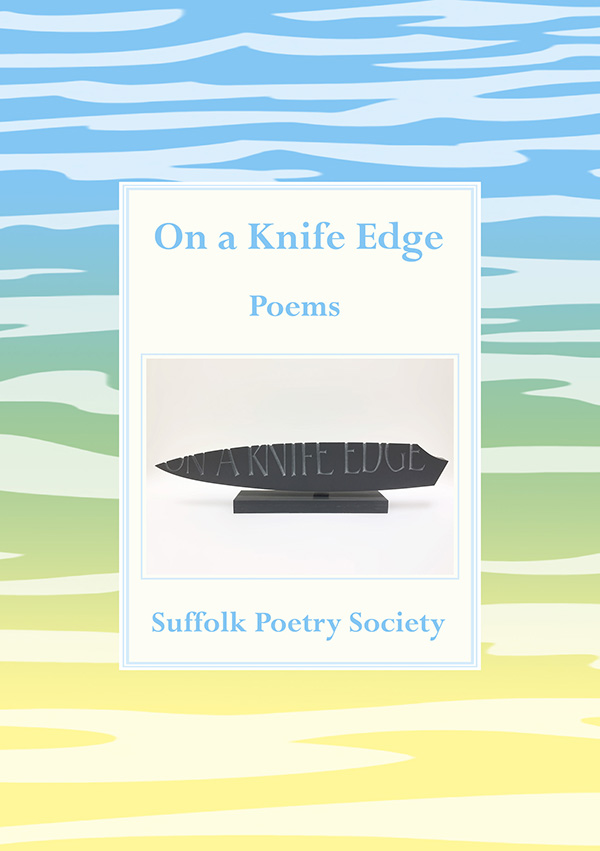
On a Knife Edge - Poems from Suffolk Poetry Society

 On a          Knife Edge cover

 This slim volume of poetry by members of Suffolk Poetry Society, aims to highlight the crisis faced by nature in the UK. It was inspired by the theme of the Lettering Arts Trust exhibition  On a Knife Edge which runs until 7th November at the Lettering Arts Centre, Snape Malting, Snape.

The poems here cover a variety of topics under the broad heading of concern for nature, including well observed descriptions of the natural world, meditations on the human relationship with nature, pleas to look after nature before it's too late and even, in Roger West's prose poem Secheresse, seasonaility of food:

 in the supermarket seasons gathered together corralled and tethered under thermostatic control.

Given that Suffolk is a coastal county of England, the sea features in several of these poems. In Sea Change 1950, Christina Buckton describes a woman's relationship with a tidal rockpool:

She is dreaming how the rockpool
opens inward
how she slides through its doorway
to a place where waves dance 

while in Where Has the Water Gone, Sue Wallace-Shaddad muses on the damage done to our oceans by oil pollution: 

A curl of water attempts
but fails to escape
the kaleidoscopic quilt
smothering the shore. 

and Richard Whiting, in Balearic Shearwater, bemoans the fact that most people wouldn't recognise individual species of seabirds:

......................................If they saw you
it would be a dark shape low over the sea
to be called a gull if anything at all.
Indifference is the mother of decay. 

It could all feel pretty hopeless (and that would be understandable, as we are living through a major crisis in terms of losing large parts of the natural world) but these poems are saved from that doom and gloom by their lyricism. There are also individual poems that encourage readers to look after nature. White Clover in the Lawn by Margaret Seymour starts with a beautiful description of clover 'appear(ing) overnight like a sudden hailstorm' and ends with a plea to 'Gentle gardeners (to) skimp on mowing.'

Caroline Gill (whose recent collection Driftwood by Starlight I reviewed here) has three poems in this anthology including  Lines on a Linnet:


Your avian lexicon is closed to me
but when you sing I feel the joy

until the music fades. 

This is an important anthology for our current times, with a good range of poetic responses to the crisis we're living through. 

On a Knife Edge published by Suffolk Poetry Society (2021)

Tuesday, 21 September 2021

Autumnal Flowers

 We're continuing to have beautiful warm weather, which is unseasonable and worrying from a climate change point of view, but very pleasant. It also makes guided walks easier and more enjoyable!

Yesterday I had arrived very early for a guided walk i was to lead around Edinburgh's wonderfully iconic Arthur's Seat. So I took the time to wander round the wildflower meadows near the Scottish Parliament building. 

The building itself has always been a bit controversial, from the high cost of building it, to the nondescript appearance, but it looks nice when viewed from the other side of the wildflower area


There are quite a few flowers still in bloom

which offer a feast for late season insects including this Volucella pellucens hoverfly 

our birdwatching walk went well too, with highlights including a sparrowhawk.

Tuesday, 14 September 2021

Roses at Saughton Park

 We had a brief walk round Saughton Park this lunchtime and enjoyed the roses! Some of them are in full glorious bloom, many are fading and some are still only in bud. Here are just a few of them


It's particularly lovely when there are a few roses together at different stages of blooming


We also saw this magnificent leopard slug!