Yesterday was International Bat Appreciation Day.
Bats are fascinating creatures, being the only group of mammals that can truly fly. They also harbour a lot of viruses, many of which have then moved into human populations (including Ebola, Lyme disease, Rabies and corona viruses, including possibly the virus responsible for the current COVID_19 pandemic that is sweeping across the world.
There is a lot of misinformation circulating about the links between bats and COVID_19, which poses a threat to bats by fuelling unfounded fear in people. However bats are not to blame for this pandemic.
Peter Daszak, President of the U.S.-based non-profit Ecohealth
Alliance, says that even if bats are the origin of the cirus, they are not to blame
for the pandemic. "It's not bats. It's us. It's what we do to bats that drives this pandemic risk," Daszak said. ".....We don't need to get rid of bats. We don't need to do anything with
bats. We've just got to leave them alone. Let them get on, doing the
good they do, flitting around at night and we will not catch their
viruses" This is a quote from an excellent article on the NPR website, you can read the whole article here.
There's another good article on the Nature website here.
Science Focus states that bats pose no bigger risk than other animals in this article.
Bat Conservation Trust has prepared a comprehensive guide to COVID_19 and bats, which you can read here.
We should conserve and protect bats and their habitats, not demonise them.
**
An excellent book to read about diseases that originated in animals and then transferred to humans is David Quammen's Spillover, which I reviewed here.
Saturday, 18 April 2020


Friday, 17 April 2020
#DailyExercise continues
We continue to enjoy our walks through a local park and two cemeteries. A couple of days ago, we met this lovely blue tit
 and the day before we saw this chiffchaff (though possibly it's a willow warbler, they're very difficult to tell apart by sight and both species are present in both the cemeteries we visit)
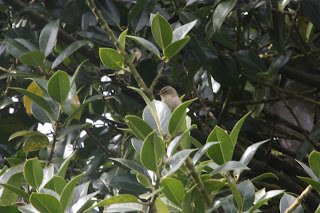 There were a few butterflies around including this lovely small tortoiseshell from one of the cemeteries
 and this peacock from the community park behind the supermarket
 We continue to regularly see bee flies (Bombylius major)
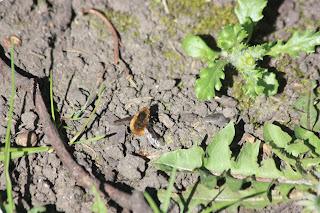 and were very happy to see this seven spot ladybird yesterday

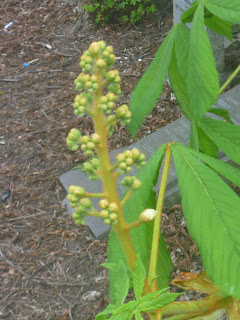
We're still watching the horse chestnut tree as it slowly comes into leaf and the flowers develop

The sycamore leaves are starting to unfurl too, they always look wonderful
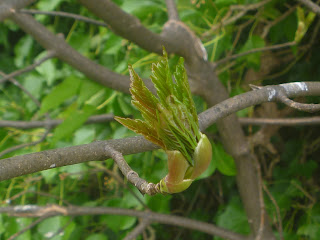

 and the white cherry blossoms are in bloom

We have also noticed a good number of interesting gravestones in the two cemeteries, I've posted a selection of these over on my Shapeshifting Green blog, here.
**
The UK Government is, at the moment, allowing us out for one form of #DailyExercise once a day in addition to visiting the shops (as infrequently as possible), travelling to work (for those with essential jobs that can't be done from home) and medical emergencies including helping those who are self isolating.


We're still watching the horse chestnut tree as it slowly comes into leaf and the flowers develop


The sycamore leaves are starting to unfurl too, they always look wonderful


**
The UK Government is, at the moment, allowing us out for one form of #DailyExercise once a day in addition to visiting the shops (as infrequently as possible), travelling to work (for those with essential jobs that can't be done from home) and medical emergencies including helping those who are self isolating.
Thursday, 16 April 2020
The Book of Shanghai edited by Jin Li & Dai Congrong

We are getting used to seeing images of China focussed on the effects of the COVID_19 coronavirus pandemic and the country's response to that. So it is very refreshing to read this collection of brilliant short stories that offer different perspectives from one of the largest cities in that huge country.
Shanghai, as described in Jin Li's introduction to this book, is not only one of the major cities of China, but also arguably the literary centre of that country. Li's piece gives a fascinating potted history of developments in Shanghai based literature set against wider historical events. In introducing the selection of stories, Jin says:
'if this book is to offer a literary map of the city, it has to be a comprehensive one. A true map cannot simply mark out the landmarks, and the most popular tourist sites, it must be able to guide readers through the city’s lesser-known corners, its dimly-lit nooks and rarely-frequented crannies.
That is to say, a literary map must reveal the joys and sorrows lurking in every crevice of Shanghai life.'
The stories here, taken together, give an interesting variety of insights into Shanghai and the lives lived in that city. Cai Jun's Suzhou River (translated by Frances Nichol), is the story that most clearly builds a picture of the physical city, which is described here as 'a giant labyrinth. The outer roads are spacious and wide, but if you come closer into the centre, over here, they are denser, narrower and windier. You can never see to the end of any street.' The story then develops into a surreal tour of the city.
Ah Fang's Lamp by Wang Anyi (translated by Helen Wang) gives a wonderful glimpse into the life of Ah Fang, a fruit vendor, with the narrator filling in the gaps of what she doesn't know about the young woman and her family. It is a lovely illustration of the casual encounters that we have every day with people we never get to know well, but how such people become part of the fabric of our every day life.
A chance encounter also forms the centre of Woman Dancing Under Stars by Teng Xiaolan (translated by Yu Yan Chen). In this engaging story a young married woman meets an older woman in a cafe and accepts the older woman's offer to teach her to dance.
The older woman in The Story of Ah Ming (Wang Zhanhei, translated by Christopher MacDonald) isn't a random stranger but the grandmother of a family who become embarassed when the old woman starts collecting rubbish. The metaphor about how we treat old people isn't subtle but the story is engaging.
Snow by Chen Danyan (translated by Paul Harris) is a vivid evocation of family life, memory and loneliness, in which Zheng Ling contemplates her life in the course of organising a family reunion. The author is very good at conveying a sense of place and atmosphere:
The early morning fog had dispersed. Between earth and sky there was nothing but snow falling continuously. She thought of the courtyard of her mother’s house, which would certainly also be covered in white and where the leaves of the evergreen trees, motionless, would have caught the snowflakes, the way they did when she was a child.
Bengal Tiger by Xia Shang (translated by Lee Anderson) looks at the conflict between two families. Chang Jing isn't afraid of the tigers he works with but is much more meek when it comes to interactions with other people. A disagreement with another zee employee is complicated when the families' children get involved.
Although most of the stories feel very realistic, The Novelist in the Attic by Shen Dacheng (translated by Jack Hargreaves) is a surreal story about a novelist who lives in the attic of a publishing company for many years while trying to write his third novel. It's a clever look at the sacrifices made during a writing career.
Surrealism and the world of publishing also collide in Fue Yuehui's story The Lost (translated by Carson Ramsdell), in which the protagonist Gu Lingzhou (who works for a publishing company) loses his mobile phone, setting off a tale of confusion and a consideration of how we keep and maintain connections in the modern world. There's some beautiful writing in this story:
'groups of farmers busy with the harvest, occasionally spooking flocks of birds into flight as they worked. Crows, perhaps? Pitch black, scattered in an instant across dusk’s quiet horizon, like little black sesame seeds sprinkled atop a cool, celadon plate. The farmers would pause from their task at
hand and gaze up at the birds, as Gu Lingzhou himself watched for a brief eternity before the feathered beings dove aslope into the lush branches of a camphor tree.'
The last story, State of Trance (Chen Qiufan, translated by Josh Stenberg) a surreal, distopian story of the end of the human world where AI is taking over. An interesting feature of this story is that some passages were generated by AI. Given the current state of the world, this is an appropriate story to finish this brilliant collection which gives so many varied pictures of Shanghai.
The Book of Shanghai edited by Dai Congrong & Dr Jin Li, published (2020) by Comma Press.
Disclaimer: I received a free electronic copy of this book in exchange for an honest review.
Wednesday, 15 April 2020
Darwin's Ghosts by Rebecca Stott
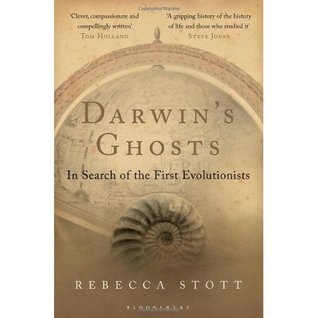
Soon after the publication of On the Origin of Species, Charles Darwin was accused of ignoring the work of those scientists who had before him come up with ideas that lead to his formulation of the theory of natural selection.
In this book, Rebecca Stott attempts to put this right by outlining the work of people going back as far as Aristotle.
It's a fascinating book,guiding the reader through the evolution of thinking about how life developed on earth. Aristotle's writings included the very first systematic studies of nature, studies which influenced thinkers throughout the ages. From then, Stott follows the lines of thought through the Persian philosopher Jahiz, thinkers of the Renaissance including Leonardo da Vinci, Charles Darwin's father Erasmus and lastly Alfred Wallace, who famously (though perhaps not famously enough) came up with the idea of evolution at about the same time as Darwin, though it was Darwin who published first and whose name will always be associated with evolution through natural selection.
Throughout the accounts of these scientists, lies the threat of religious persecution. All of these well educated and influential men (and they were all men, Stott recounts being sad that she could find no women to include) were reluctant to publish their thoughts under their own name.
Until we reach Alfred Wallace, none of these scientists were producing theories that actually look anything like evolution as we know think of it, but it is fascinating to read how ideas developed, how people's way of looking at the world evolved through time.
A good read for anyone interested in the history of science and ideas.
Darwin's Ghosts by Rebecca Stott, published by Bloomsbury (2012).
Tuesday, 14 April 2020
Beautiful peacock butterfly
We saw this absolutely beautiful peacock butterfly today in the wee park behind the supermarket,

though we saw hardly any butterflies in the cemeteries despite the sunshine.
The few flowered leeks are in full bloom now
 as are the elms
 while the sycamores are starting to leaf and flower
 and the coltsfoot are already starting to turn

 and this Syrphus sp hoverfly
 ***
***
The UK Government is, at the moment, allowing us out for one form of #DailyExercise once a day in addition to visiting the shops (as infrequently as possible), travelling to work (for those with essential jobs that can't be done from home) and medical emergencies including helping those who are self isolating.

though we saw hardly any butterflies in the cemeteries despite the sunshine.
The few flowered leeks are in full bloom now


It was lovely to see two Bombylius major bee flies


The UK Government is, at the moment, allowing us out for one form of #DailyExercise once a day in addition to visiting the shops (as infrequently as possible), travelling to work (for those with essential jobs that can't be done from home) and medical emergencies including helping those who are self isolating.
Monday, 13 April 2020
Chocolate Mining Bees and more on our #DailyExercise walk
There's something appropriate about seeing chocolate mining bees (Andrena scotica) so close to Easter. We first noticed a colony of these bees on Friday (you can read more about Friday's #DailyExercise walk in this blogpost). Today we found another colony of these lovely bees close to the original colony
 These bees were quite quiet as it was cool and dull when we were out (though it is sunnier and warmer just now). Mining bees are solitary bees, so called because they nest separately rather than in a
hive, but their nests are often close together and they're often seen
in groups.
These bees were quite quiet as it was cool and dull when we were out (though it is sunnier and warmer just now). Mining bees are solitary bees, so called because they nest separately rather than in a
hive, but their nests are often close together and they're often seen
in groups.
The cherry trees will soon be in bloom, these are the trees in our street

and here is some of the blossom on a tree in one of the cemeteries

 The ash trees are blooming beautifully
 and the leaves and buds on the horse chestnut continue to develop
 The cemeteries are full of birdsong including chaffinches, wrens, robins, blackcaps, willow warblers and chiffchaffs. We've also seen goldcrests, blue tits, great tits, goldfinches, bullfinches and blackbirds. We've occasionally heard or seen great spotted woodpeckers, mistle thrushes and one unexpected pheasant (whose photo you can see in this blogpost).
***
The UK Government is, at the moment, allowing us out for one form of #DailyExercise once a day in addition to visiting the shops (as infrequently as possible), travelling to work (for those with essential jobs that can't be done from home) and medical emergencies including helping those who are self isolating. Though there are suggestions that the privilege of outdoor exercise may be removed because of the actions of some people who have been gathering in greenspaces without paying any attention to the need for proper social distancing.

The cherry trees will soon be in bloom, these are the trees in our street

and here is some of the blossom on a tree in one of the cemeteries


***
The UK Government is, at the moment, allowing us out for one form of #DailyExercise once a day in addition to visiting the shops (as infrequently as possible), travelling to work (for those with essential jobs that can't be done from home) and medical emergencies including helping those who are self isolating. Though there are suggestions that the privilege of outdoor exercise may be removed because of the actions of some people who have been gathering in greenspaces without paying any attention to the need for proper social distancing.
Sunday, 12 April 2020


Subscribe to:
Posts (Atom)