I've just started teaching a course on Environmental Writing for The University of Edinburgh's Office of Lifelong Learning. A couple of people mentioned on Facebook that they would be interested in doing this course as an e-learning course. So after discussing it with my supervisor, I am now able to offer this course as an e-learning opportunity for people who live outside the UK. (This is to avoid undermining the viability of the course at the University and to avoid making arbitrary decisions about UK geography). In the first instance I'm offering it as a FREE pilot course, using weekly email exchanges and asking every participant to fill out an evaluation form so that I can assess how successful the course is and whether it is worth offering in the future, including the possibility of developing it as an online group learning experience.
The original two people who expressed interest will be taking this course and I am opening it up to probably another three people. So if you regularly comment on this blog or are a friend of mine on Facebook, live outside the UK and are interested in taking this course as an online learning opportunity then please let me know why you're interested in the comments below and I'll put names in a hat and choose!
The e-learning course will start sometime soon after I finish teaching the course at the University, probably mid-November.
Thursday, 30 September 2010


Wednesday, 29 September 2010
Field Notes from a Catastrophe by Elizabeth Kolbert
Field Notes from a Catastrophe by Elizabeth Kolbert describes itself as a frontline Report on Climate Change. It's an accessible, concise and cogent look at climate change covering the history of climate change and climate science, the effects of climate change on wildlife and on human settlements, the political aspects and some ideas on climate change mitigation.
The author has visited many places that are affected by climate change. She reports on scientific explorations of permafrost, explaining how important it is as a carbon store and how rising temperatures undermine this role. She travels to the Arctice seas where she learns to recognise seasonal sea ice by taste (it is salty compared to the fresh water that is stored in permanent sea ice). She also learns about the albedo affect, such that white surfaces (eg ice) reflect sun and so help to keep the temperature low whereas dark surfaces (eg open sea) absorb sunlight and heat up. This sets up a feedback loop such tat as more ice melts there is more open sea to absorb more heat and thus to heat up the planet more quickly.
We are taken through a history of how the climate has changed from prehistoric times and how the relative stability of the climate since the ice Ages has allowed civilisation to develop and how extreme climatic events have caused some civilisations to collapse (this is a theme that is explored in much more detail in Jared Diamond's book Collapse, which inexplicably I've not reviewed on this blog!).
A chapter of the book is devoted to how some communities are mitigating against climate change. In parts of the Netherlands (a country that lies below sea level that is kept dry by complicated systems of dykes and pumps) where people are starting to live in floating houses, and areas of the same country where low lying land is being allowed to revert back to the sea to increase the chances of saving other areas. The community of Burlington in Vermont is highlighted as one where citizens are all taking a lot of positive steps to reduce their energy consumption (and this is being replicated in other places too).
The book was published in 2005 and some things obviously have changed (George W Bush is no longer president of the USA for example) but much remains depressingly exactly the same. This is an incredibly sobering book and one that really everyone should read. As is Six Degrees by Mark Lynas which I'm currently reading and will review in the near future.
Field Notes from a Catastrophe by Elizabeth Kolbert published 2006 by Bloomsbury on paper certified by the Forest Stewardship Council.
Monday, 27 September 2010
Saturday, 25 September 2010
Musselburgh Lagoons

We went to Musselburgh today, and walked along the Esk river and
round the shore to the Musselburgh Lagoons. The Lagoons, were created in 1964 by the South of Scotland Electricity Board. Three hundred acres of land have been reclaimed from the sea with pulverised fuel ash from Cockenzie Power Station. The area has become an important area for wading birds and sea ducks and has nice tree lined paths that lead to concrete bird hides. The hides are basic and open to the elements so I guess it's an uncomfortable experience in winter, which is one of the best times for birdwatching here! When we were there the tide was well out and there was a strong wind, which meant that birdwatching on the mudflats was difficult with the birds being far away and the binoculars difficult to hold steady. A low tide also means that the birds don't flock in huge numbers to the lagoons. However we did see lots of curlews (both on the mudflats and the lagoons), oystercatchers, redshank, goosanders and eider on the mudflats and wigeon (one of my favourite ducks!) and lapwings on the lagoons. I love watching lapwings and it was wonderful to see them in good number as they have become so rare these days. We also saw a shelduck and a heron on the lagoons; greylag geese and Canada geese further upriver. Also a few last swallows flying over the lagoons!
A few years ago the lagoons were threatened by the development of an extension to the nearby racecourse, but the development was not given planning permission so at least for now the birds can all enjoy this wonderful area and we can enjoy the birds!
Friday, 24 September 2010
Liftshare
Liftsharing can help you to reduce your carbon footprint and get to know your neighbours or work colleagues better! Find someone travelling your way so you can share your journey, save money, cut your carbon footprint and have fun!
In the UK it is National Liftshare Week 4-8 October. You can find out more here.
I don't liftshare on a regular basis, I either walk or take the bus. Sometimes I take lifts with people after poetry events. I would liftshare more regularly if it was appropriate and I could find someone going the same route as I was doing.
Do you liftshare? What have your experiences been?
If you're in the Uk and interested in liftsharing, then you can register your interest on the Liftshare website here and they can find a match for you.
In the UK it is National Liftshare Week 4-8 October. You can find out more here.
I don't liftshare on a regular basis, I either walk or take the bus. Sometimes I take lifts with people after poetry events. I would liftshare more regularly if it was appropriate and I could find someone going the same route as I was doing.
Do you liftshare? What have your experiences been?
If you're in the Uk and interested in liftsharing, then you can register your interest on the Liftshare website here and they can find a match for you.
Thursday, 23 September 2010
Altered Book - Autumn
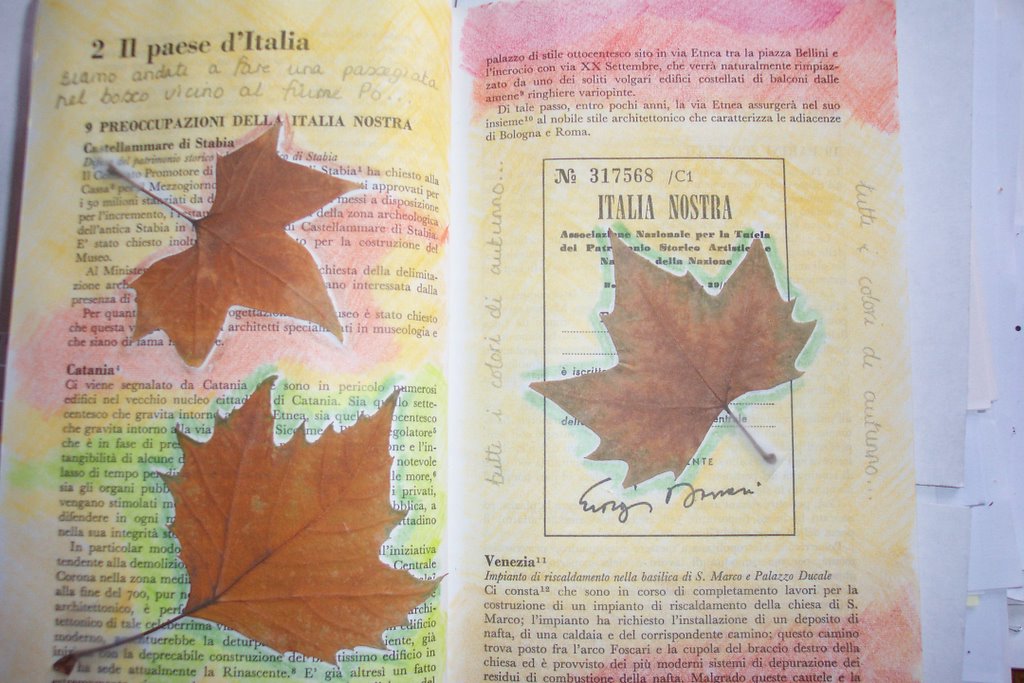
I thought it might be nice to revisit the altered book I made after I'd visited Italy a few years ago now.
I made the book from an old anthology of articles from the Italian press. You can see the original book in this post.
This is the autumn colour page of the book. The background is an article about Italia Nostra, which is an Italian conservation group. The leaves we found on a walk in the woods near the River Po in Torino. I coloured the background in pencil crayon.
Tuesday, 21 September 2010
Love and Garbage by Ivan Klima
This is an excellent novel (at least partially autobiographical) following the life of a writer as he gives up his essay on Kafka to work as a road sweeper in Prague in Cummunist Czechslovakia. From an environmental point of view, the garbage is the most interesting element of the novel. Although the novel doesn't take a specifically environmental stance the fact is it deals with a vastly important environmental issue, how we deal with our rubbish.
The narrator's work as a garbage collector stimulates his meditations on how people were treated as garbage in the ghettos and concentration camps in Nazi Europe which he had lived through as a child. This stimulates the reader to think about how our throwaway society may affect our attitudes to our fellow human beings and in fact other living creatures we share our planet with.
The whole narrative is fairly meandering and moves seamlessly through different time periods and different themes. Kafka is referred to a lot, he's obviously a great influence on the narrator, despite him having given up on his essay!
Love and Garbage by Ivan Klima published 1986 by Penguin
The narrator's work as a garbage collector stimulates his meditations on how people were treated as garbage in the ghettos and concentration camps in Nazi Europe which he had lived through as a child. This stimulates the reader to think about how our throwaway society may affect our attitudes to our fellow human beings and in fact other living creatures we share our planet with.
The whole narrative is fairly meandering and moves seamlessly through different time periods and different themes. Kafka is referred to a lot, he's obviously a great influence on the narrator, despite him having given up on his essay!
Love and Garbage by Ivan Klima published 1986 by Penguin
Subscribe to:
Posts (Atom)