Monday, 13 May 2019

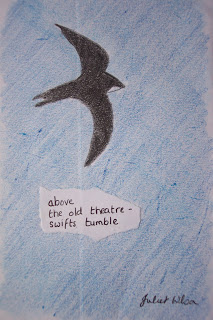
The Return of the Swifts 2019


Do you see the swifts are here again?
They swoop so low and soar so high
I think there may be more than ten -
do you see the swifts are here again?
We know it's summer round here when
our favourite bird comes gliding by
You see the swifts are here! Again
they sweep so low and soar so high!


**

Swifts returned to the skies above our area of Edinburgh today! 

Swifts only visit Scotland for just over three months in the year (May to August) and spend the rest of the year flying down to Africa and then round and round Africa before coming back to the same nest site. They only land when they're nesting, when the young leave the nest they remain airborne for three or four years before they make their first nest! Swifts are declining in the UK for a number of reasons but one is the lack of nest sites - they nest in holes in walls and under roofs and these days these holes are often blocked up when buildings are renovated. The City of Edinburgh Council (and some other councils in the UK) advise that swift bricks be used in new buildings over a certain height (a swift brick is a brick that is hollow inside and includes an entrance hole so that the swifts can enter the nest) but they can't enforce this.

Some links about swifts

Swift starter kits and how adding ‘nest forms’ to swift boxes makes common swifts more than four times more likely to use the boxes - read more on Mark Avery's blog here.

Celebrating swifts with the RSPB here.

Instructions on how to make a nest box for swifts from the RSPB here.

A very impressive example of swift nestboxes installed in industrial buildings in the Netherlands. The article is in Dutch, but the photos are worth looking at, even if you don't understand Dutch.  

Wednesday, 8 May 2019

The Animals Decide to Become Invisible

Tigers went first, they were tired
of being accused over every cow
that went missing so faded away
to sunset stripes that shimmered
then were gone.

Lions, jaguars, leopards and cheetahs
vanished, chasing their fast fading prey,
their roars and growls hung
in the air for a while
then silence.

Polar bears slid over ice into virtual dens,
burrowing into new dimensions
where they met penguins
and walruses slipping equally fast
out of sight.

Fish, frogs and snakes buried themselves
in mud, wriggled for a time
then went still, while the birds
spiralled away
into cloud.

Finally, domestic cats prowled
down their secret highways
curious to know where the mice
had gone, miaows echoing
in our memories.

Leaving only pet dogs,
too obedient to leave our sides
but wondering what had happened
to all the smells
they used to love.

**
This poem was originally published in Orbis magazine a few years ago but I'm posting it here now to mark the publication of the Global Assessment report from the
Intergovernmental Science-Policy Platform on Biodiversity and Ecosystem Services (IPBES) warning that 1 million animal and plant species are facing extinction because of human activity.

Tuesday, 7 May 2019

The History of Bees by Maja Lunde

 The History of Bees

This novel is made up of three stories about people who are connected with bees.

In 1851 William is a biologist and seed merchant who keeps bees and wants to design a new type of hive, but always seems to be behind the times.

In 2007 George keeps bees in the USA and finds his hives hit by Colony Collapse Disorder, threatening his livelihood and with wider implications for farming across the country.

2098 Tao lives in China, in a world where the bees have died out and she is one of the people employed to hand pollinate fruit trees.

All three characters have sons and the parent-child relationship is as important a part of the stories as is the human-bee relationship.

I didn't really get into this book, though I was interested in the way it looks at our relationship with bees and the wider environment. I couldn't really engage with any of the characters and I found the long drawn out search for what was wrong with Tao's son to be tedious, because to me, reading in 2019 it seemed obvious what had happened to him (though acknowledging that to Tao it wouldn't be). I did like the ending, where things are brought together and though the ending is in many ways depressing there is also hope.

I also struggled in a sense with reading a book where one part of the story is set in the UK and one in the US but it was originally written in Norwegian and translated by an American. So the UK section and the US section both seem American, which is annoying and is an issue of translation rather than the original writing.

The History of Bees by Maja Lunde, translated by Diane Oatley published by Simon and Schuster (2017)

Monday, 6 May 2019

Bank Holiday in the Dells

Today being a bank holiday, Crafty Green Boyfriend joined me for my weekly patrol of the Dells alongside the Water of Leith. The weather was mostly dull with a fair bit of rain, but there were still some lovely signs of Spring around.

The hornbeam trees are starting to develop their beautiful chandelier type fruits

These will develop to be their most beautiful in October, as you can see in this post from a few years ago.

Meanwhile the wych elms are covered in more flowers than it seems possible to fit in the available space

 and the horse chestnuts are beautifully in bloom

and the harts tongue ferns are unfurling their shiny new fronds


We were both intrigued to see this patch of wild garlic where some of the leaves are striped

I'm not sure if that is a common occurence, it's certainly not something either of us have ever seen before.

These lovely fungi, growing in one of the recently planted wild flower meadows are, I think, fairy parasol fungi (please correct me if you know otherwise!)

**
The Charter for Trees, Woods and People sets out:

* the role trees and woods play in our lives,

* the rights we all have to the benefits trees and woodland provide, and

* our responsibilities towards maintaining and supporting them.

Each of the charter's principles articulate the relationship between people and trees in the UK in the 21st Century. The Tree Charter Principle for May is Recover Health, Hope and Wellbeing with the Help of Trees and what better way to do that than to go for a walk in the woods! You can find out more about the Tree Charter and sign up to it here.


Sunday, 5 May 2019

Open Day at Granton Castle Walled Garden

Yesterday Granton Castle Walled Garden held an open day! We had never visited the gardens before - they were more or less derelict for years and volunteers have been working since 2013 to renovate them. Last spring, excavations of the foundation of the castle look-out tower revealed that the Granton Estate dates back to around 1160. You can find out more about the castle's history and how to get involved on the Friends of Granton Castle Walled Garden blog.

There were a range of activities going on but mostly it was just an opportunity to explore the gardens. In the photo below you can see the iconic Granton gasometer in the background.

 The kitchen gardens already look wonderfully productive 

with informative labels to explain some of the berbs

the chives look particularly beautiful just now as their flowers are just opening


Musicians were playing in the tent

and there was the chance to try your hand at weaving with natural materials on a large loom

There was a little display of artist's books

and mini artworks throughout the garden


including the bunting! Regular readers of this blog may remember that I made some bunting for this exhibition (see this post for one of the leaves I made). The photo below shows both my leaves at the two sides with other people's leaves in between.
It was lovely to see the variety of leaf designs that people had made


Most of the arts were made by Cass of Bookbinding with Cass or by people who have attended her events. Cass is committed to using upcycled and natural materials in her crafts.

Granton Walled Gardens are open to the public the first Saturday of every month or you can get involved as a volunteer. They also run a range of activities including crafting workshops - you can find out more about how to volunteer and get involved here.

Saturday, 4 May 2019

Spring Woodlands in Full Bloom at Dalkeith Country Park

We've got a long bank holday weekend so yesterday we went to Dalkeith Country Park hoping to see the bluebells. We weren't disappointed, in fact the bluebells, ramsons (wild garlic) and stitchwort were all at their best throughout the park.

 bluebells


wild garlic (ramsons)
stitchwort 

Large areas of the park are covered in these three species 


 and often they're found together 

 
 This lovely area in the photo below was full of butterflies 

There were a couple of orange tips


and at least five speckled woods, two of which were spiralling round each other into the tree canopy, though that was too difficult to catch on camera

Dalkeith Country Park is most famed for its ancient oak woodland, full of wonderfully gnarled old oak trees


and it's well worth taking a close look at the bark of these trees

The river that runs through the park is lovely too

There are also lots of lichens

ferns, like this maidenhair spleenwort

and more flowers like these cowslips

Dalkeith Country Park is always a great place to visit, especially at this time of year. It recently had the old stableyard renovated and there are two cafes, a shop and other amenities including an adventure playground and there's a calendar of events happening throughout the year. But the park is big enough to absorb all this activity without disturbing the lovely natural tranquillity of the wider area of the park.


Wednesday, 1 May 2019

Walk this May - National Walking Month

Walking is good for you, it is a great, gentle form of exercise and doesn't need any special equipment or clothing so is accessible to everyone who has the mobility.

You can walk at the pace to suit you and walking allows you to stop and observe along the way, whether that's window shopping, noticing architectural details or observing nature.

If more people walked for short journeys then there would be fewer vehicles on the roads and so less air pollution and less fuel used.

Of course it's not all easy:

If you walk on the pavement along main roads then you risk inhaling air pollution

Many towns and cities are not pedestrian friendly, many don't have good pavements or crossing places and many may not feel safe, particularly after dark or for elderly people or children.

There are some things that we can do ourselves to make walking in built up areas better:

choose to walk along minor roads, this cuts down a lot on the effect of pollution

join a campaign, such as Living Streets to push for better, more walkable communities

And there are some things that need to be done at an organisational level:

communities need to be designed for pedestrians, cyclists, mobility scooters, prams and public transport

low speed zones need to be brought in to reduce accidents

electric and hybrid cars need to become the norm to reduce pollution in built up areas

people need to be encouraged to move from cars into other forms of transport

If you're looking for ideas on how to make the most of enjoying walking, the Tree Council share some ideas on how to enjoy walking in the woods this month.

Edinburgh is a very walkable city in some ways though it becomes less so as the volume of traffic increases all the time and some road junctions seem designed to keep pedestrians waiting forever before we can cross. The city does have some lovely green spaces to walk in, and here are just a few of my favourites:

Corstorphine Hill

Midmar Paddock (likely to disappear under housing in the near future - see this post for details)

Figgate Park 

Craiglockart Dell, Water of Leith Walkway

 Where are your favourite places to walk?

How walkable is the place where you live?

May is National Walking Month, you can find out more here.