Edinburgh International Science Festival launched it's programme for 2013 this morning. To commemorate the festival's 25th anniversary, the theme this year is The Future.Three of the strands include events of particular interest for those interested in environmental issues:
Future Foods will explore what we might be eating in the future, with events including Eating Aliens which will discuss whether eating invasive plant species might be the best way of controlling them (including a three course lunch of dishes made using invasive species)
Future Cities will explore possible futures for our urban centres with events including Greening the City in which experts from Gorgie City Farm and Greenspace Scotland explore various ways in which cities can be made more green.
Future Challenges will focus on some of the myriad challenges facing us as the human population continues to expand with events including Water, Water Everywhere which will explore how we will deal with managing our water resources in the future.
There are events for all ages, many of which are free including:
Forestry DNA Detectives for children over 5 which will explore the science around DNA
Dung Days at the Zoo in which you can investigate, well, dung and learn to identify which animal leaves which type of dung (this event is free, but you'll need to pay the usual entrance fee to get into the zoo)
Patterns in Nature, one of several art exhibitions that will be on show leading up to and during the festival.
And for those who feel that cute and cuddly wildlife such as pandas get too much attention, the Ugly Animal Preservation Society will be arguing the case for the appeal of the aesthetically challenged species.
Edinburgh International Science Festival will take place at venues across the city from 23 March - 7 April.
As ever, red text contains hyperlinks that take you to other webpages where you can find out more.
Thursday, 31 January 2013


Wednesday, 30 January 2013
Kittens in an Italian hill town
In yesterday's review of The Holy Place, the poetry book from Caroline Gill and John Dotson, I said that Caroline's poem Monte Testaccio: Mound of Potsherds reminded me of some feral cats Crafty Green Boyfriend and I had met in Italy several years ago now.
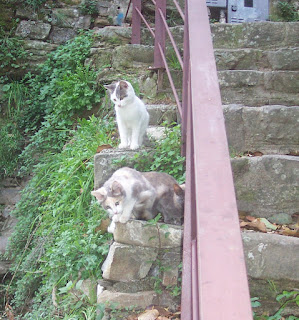
Tommaso Gervasutti had wanted to know more, so here is a photo of the cats, that we met in Dolceaqua in the northern corner of Italy, near the border with France. The cats seemed to live by themselves in the mediaeval old town. They were quite wary (and quite smelly too!) but one of them let Crafty Green Boyfriend pick it up.
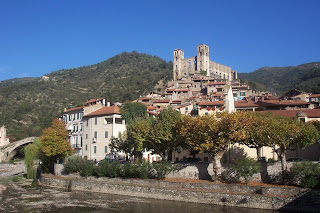
 And here's a photo of Dolceaqua, as it's a very photogenic place!
 As ever, red text contains hyperlinks that take you to other webpages where you can find out more.
Tommaso Gervasutti had wanted to know more, so here is a photo of the cats, that we met in Dolceaqua in the northern corner of Italy, near the border with France. The cats seemed to live by themselves in the mediaeval old town. They were quite wary (and quite smelly too!) but one of them let Crafty Green Boyfriend pick it up.


Tuesday, 29 January 2013
The Holy Place - poetry by Caroline Gill and John Dotson
I recently bought a copy of The Holy Place, poetry by John Dotson and Caroline Gill.
The two poets have very different but complementary styles. John's poetry is mostly minimalist. I particularly like:
let's take cicadas then
in madly chanting crescendoes
along the honey suckle-lined
mud pathed riverbank.
*
The second half of the book is devoted to Caroline's poetry. Caroline may be a bit of a rarity these days in that she writes formal poetry and writes it well. Her sestina The Figure at the Phoenix Mine included in this book won the Petra Kenney Poetry Competition in 2007.
She's also (as anyone who reads her Wild and Wonderful blog will know) a keen naturalist. Many of the poems here are informed by this love of nature. Ice Maiden of Zennor features a snowy owl that very unusually was spotted in Cornwall. The poem in its rhythms and cadences is a little reminiscent of Poe's The Raven:
Silent flakes are floating gently
high above the ocean spray;
owlish eyes look innocently
on the sailor's winter way.
There's also a hint of Poe again in Monte Testaccio: Mound of Potsherds though it features cats rather than a bird:
Can you hear the paws
that prowl proprietorially
and saunter round the cemetery
beside the Pauline Gate?
This poem took me right back to a mountain village in Italy several years ago where Crafty Green Boyfriend and I discovered a group of cute (and quite smelly) feral cats that were prowling most proprietorially!
This book is very good value too at only £3.50 including postage and packing within the UK.
The two poets have very different but complementary styles. John's poetry is mostly minimalist. I particularly like:
let's take cicadas then
in madly chanting crescendoes
along the honey suckle-lined
mud pathed riverbank.
*
The second half of the book is devoted to Caroline's poetry. Caroline may be a bit of a rarity these days in that she writes formal poetry and writes it well. Her sestina The Figure at the Phoenix Mine included in this book won the Petra Kenney Poetry Competition in 2007.
She's also (as anyone who reads her Wild and Wonderful blog will know) a keen naturalist. Many of the poems here are informed by this love of nature. Ice Maiden of Zennor features a snowy owl that very unusually was spotted in Cornwall. The poem in its rhythms and cadences is a little reminiscent of Poe's The Raven:
Silent flakes are floating gently
high above the ocean spray;
owlish eyes look innocently
on the sailor's winter way.
There's also a hint of Poe again in Monte Testaccio: Mound of Potsherds though it features cats rather than a bird:
Can you hear the paws
that prowl proprietorially
and saunter round the cemetery
beside the Pauline Gate?
This poem took me right back to a mountain village in Italy several years ago where Crafty Green Boyfriend and I discovered a group of cute (and quite smelly) feral cats that were prowling most proprietorially!
This book is very good value too at only £3.50 including postage and packing within the UK.
Monday, 28 January 2013
Upcycled gift bag

This little bag originally had the words 'Hand Baked Biscuits' printed on it. Well in fact it still does, but you can't see those words any more because I sewed on a length of pretty fabric! I added the button just as a design feature. And now it's a lovely gift bag.
Maybe I should do 'before and after' photos when I share my crafting projects here? What do you think?
*
Meanwhile, I've added another beaded bookmark to the Crafty Green Poet Etsy shop.
As ever, red text contains hyperlinks that take you to other webpages where you can find out more.
Saturday, 26 January 2013
Figgate Park
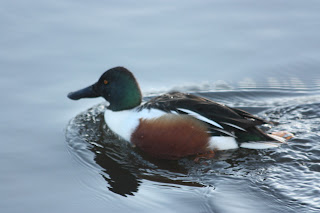
We went along to Figgate Park today, which is a small park with a stream and a pond and some trees. We were delighted by the number of birds we saw there. Figgate Pond often attracts unusual ducks and today was no exception, we got lovely views of the handsome male shoveller
Thanks to Crafty Green Boyfriend for the photos!
This weekend is the RSPB Big Garden Birdwatch. As we don't have a garden (well we theoretically have part share in a garden, but there's nowhere in it to sit and observe birds without drawing the attention of one of our neighbours and his dogs and it's not visible from our flat so its far from ideal for the garden birdwatch) we did our Big Garden Birdwatch informally at Figgate Park. As well as the shoveller, gadwall and coot, we also saw:
woodpigeons; magpies; long tailed tits: great tits: blue tits: robins: blackbirds; treecreeper; moorhens; black headed gulls; feral pigeons; mallards; Canada Geese; greylag goose: tufted ducks; mute swans: grey heron; dipper; fieldfare and mistle thrushes.
If you're in the UK, you still have time to take part in the Big Garden Birdwatch this weekend! You can also take part in Birdtrack, which allows you to record all the birds you see.
*
and my haiku on Daily Haiku today is here.
As ever, red text contains hyperlinks that take you to other pages where you can find out more

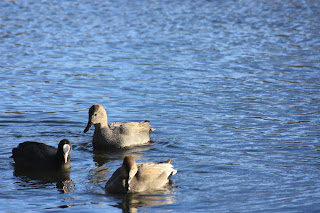
and three male gadwalls, two of which are seen below with a coot. The male gadwall is an understated, elegant duck and this is the first time I've had a really good view. The female gadwall looks like a small female mallard.

Thanks to Crafty Green Boyfriend for the photos!
This weekend is the RSPB Big Garden Birdwatch. As we don't have a garden (well we theoretically have part share in a garden, but there's nowhere in it to sit and observe birds without drawing the attention of one of our neighbours and his dogs and it's not visible from our flat so its far from ideal for the garden birdwatch) we did our Big Garden Birdwatch informally at Figgate Park. As well as the shoveller, gadwall and coot, we also saw:
woodpigeons; magpies; long tailed tits: great tits: blue tits: robins: blackbirds; treecreeper; moorhens; black headed gulls; feral pigeons; mallards; Canada Geese; greylag goose: tufted ducks; mute swans: grey heron; dipper; fieldfare and mistle thrushes.
If you're in the UK, you still have time to take part in the Big Garden Birdwatch this weekend! You can also take part in Birdtrack, which allows you to record all the birds you see.
*
and my haiku on Daily Haiku today is here.
As ever, red text contains hyperlinks that take you to other pages where you can find out more
Friday, 25 January 2013
Surviving Progress
This documentary film, based on Ronald Wright's best-selling book “A Short History Of Progress”, explores whether human civilisation can be said to genuinely be making progress and just what is progress any way?
The film starts at looking at human psychology, and states that what makes us differ from the apes is our ability to ask why. However it also suggests that physically, emotionally and mentally we haven't developed all that far beyond the first humans. We're still effectively ice age hunters trying to cope with the bewildering economic and cultural developments of human civilisation.
Are we in fact in the middle of a progress trap? Wright offers an example of a very early progress trap, when prehistoric hunters found that rather than just killing the mammoths they needed to eat they could trap whole herds of mammoths. This looked like great progress until the mammoths starting running out and the hunters lost a valuable source of food. (Sound familiar at all?)
The film then looks at progress made by humans across the world and examines it's sustainability: rampant consumerism, deforestation, genetic engineering, space exploration.
The film interviews politicians, environmentalists (including Jane Goodall) writers (including Margaret Atwood) and economists, all of whom give their perspectives on progress.
It's a thought provoking film, worth trying to see it if you can.
Surviving Progress is showing at the Filmhouse, Edinburgh tonight at 6.15 and tomorrow at 1.10. Find your local screening here. If you're in the UK or Ireland you can also watch the film on the new Filmhouse Player here (you will need to sign up and pay for this service).
As ever, red text contains hyper-links that take you to other web-pages where you can find out more.
The film starts at looking at human psychology, and states that what makes us differ from the apes is our ability to ask why. However it also suggests that physically, emotionally and mentally we haven't developed all that far beyond the first humans. We're still effectively ice age hunters trying to cope with the bewildering economic and cultural developments of human civilisation.
Are we in fact in the middle of a progress trap? Wright offers an example of a very early progress trap, when prehistoric hunters found that rather than just killing the mammoths they needed to eat they could trap whole herds of mammoths. This looked like great progress until the mammoths starting running out and the hunters lost a valuable source of food. (Sound familiar at all?)
The film then looks at progress made by humans across the world and examines it's sustainability: rampant consumerism, deforestation, genetic engineering, space exploration.
The film interviews politicians, environmentalists (including Jane Goodall) writers (including Margaret Atwood) and economists, all of whom give their perspectives on progress.
It's a thought provoking film, worth trying to see it if you can.
Surviving Progress is showing at the Filmhouse, Edinburgh tonight at 6.15 and tomorrow at 1.10. Find your local screening here. If you're in the UK or Ireland you can also watch the film on the new Filmhouse Player here (you will need to sign up and pay for this service).
As ever, red text contains hyper-links that take you to other web-pages where you can find out more.
So Sad for the rhinos
Rhinos are just one of the animals that are severely threatened by poaching.
The northern subspecies of the white rhino is so rare that it is given it's own armed bodyguards in the Ol Pejeta Conservancy of Kenya. The animals have their horns surgically removed (which is shown to deter poachers and to not have a detrimental effect on the health of the animal) and then are looked after by armed guards.
You can read more and see a photo here.
There's something just so tragically sad about this.
The northern subspecies of the white rhino is so rare that it is given it's own armed bodyguards in the Ol Pejeta Conservancy of Kenya. The animals have their horns surgically removed (which is shown to deter poachers and to not have a detrimental effect on the health of the animal) and then are looked after by armed guards.
You can read more and see a photo here.
There's something just so tragically sad about this.
Subscribe to:
Posts (Atom)